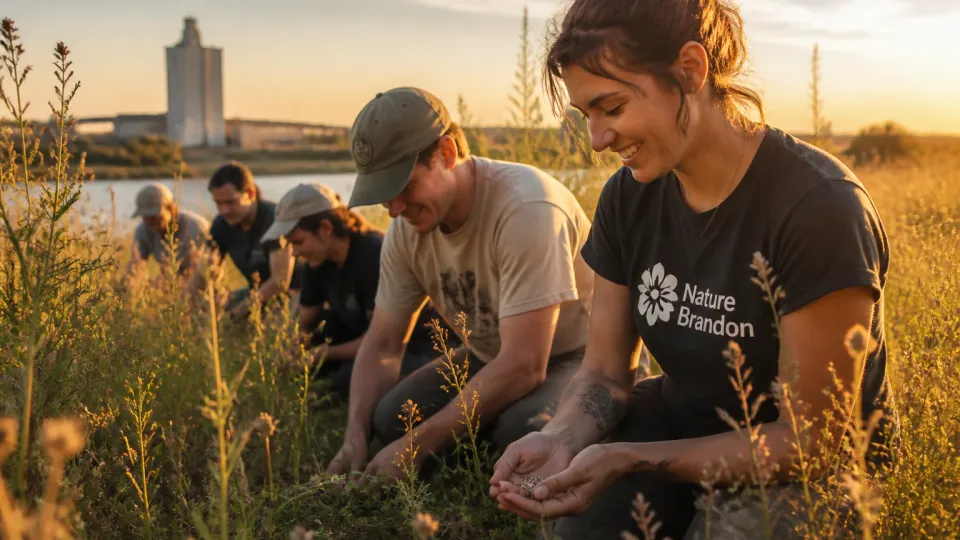
On a cool morning in late May, a dozen volunteers under wide-brimmed hats move with steady choreography through a small city block along the Assiniboine's south bank. They kneel in the loamy soil, pressing tiny seeds into shallow furrows—purple prairie coneflower, little bluestem, and anise hyssop—species that once stitched this landscape into a continuous prairie band. Children trail behind with seed packets and magnifying glasses. Across the street a retired teacher prunes non-native shrubs she has spent three seasons removing. The project is quiet and ordinary; its ambitions are anything but.
'It feels like we are making a place everyone can go to and remember what belonged here before,' says Maya Thompson, the initiative's coordinator and a biology alumna from Brandon University. 'People bring stories and tools and tea. The work is ecological, but it’s also about stitching memory back into the ground.'
What began two years ago as an effort to beautify a handful of vacant lots has become the Brandon Urban Prairie Project, a grassroots movement to restore native prairie fragments, create pollinator corridors, and turn overlooked public land into active sites of stewardship. The project now manages roughly 12 acres across 10 parcels, has mobilized more than 300 volunteers, and has partnered with Brandon University, local conservationists, and city parks staff to codify a model that other Westman communities are watching closely.
The project’s power lies in specificity. Volunteers map each site’s soil, sun exposure, and invasive species load; they collect regionally adapted seed from remnant prairies and maintain a small community seed bank in an old storefront. Rather than imposing an idealized prairie, the team works with what exists: a pocket of intact wormwood here, a surviving colony of small-flowered beardtongue there. 'We learn from the patches that survived the plow,' Thompson says. 'Those plants know this place better than any planting guide.'
Local school groups come during planting season. Miguel Ruiz, a Grade 11 student who joined through a community service program, says the work taught him more about ecology than any textbook. 'We counted bees the other day and got excited when we saw a new species,' he says. 'I started noticing the sky and the insects—things I used to miss.'
Indigenous knowledge has become central to the project. Elder Mary Sinclair, a Métis knowledge-keeper, leads listening walks where she teaches about plant uses and seasonal cycles. 'Restoration is not only about plants,' Sinclair says. 'It is about ceremony, names, and relationships. When we remember those, the land responds.' Her guidance helped the team prioritize species that offer food and medicine while bolstering pollinator networks.
Measurable outcomes are beginning to accrue. Annual pollinator surveys coordinated with Brandon University show pollinator counts up about 40 percent at restored sites compared with control lots. The seed bank catalogs over 30 native species, and early soil carbon tests suggest modest sequestration gains—an estimated five tonnes of CO2e per year across managed parcels, once established. Those numbers are modest compared with industrial offsets, but they matter for a temperate prairie city where compaction, monoculture lawns, and hard surfaces predominate.
The initiative also functions as informal social infrastructure. Neighbors who once complained about tall grass and litter now coordinate potlucks on restored lots. The city’s parks staff report fewer complaints and more volunteer stewardship hours, prompting a pilot policy that offers smaller parcels for community-led restoration under a simple custodial agreement. For retired residents like Lorraine Pelletier, the project has been a lifeline. 'I used to walk around feeling useless after my husband died,' she says. 'Now I come out and people know my name. I feel needed again.'
The work is not without trade-offs. Seasonally, people grumble about untidy stems in winter, and some homeowners resist shifting lawn norms. Funding remains precarious—grants cover seeds, basic tools, and a part-time outreach coordinator, but long-term maintenance, including adaptive management of invasive species, requires deeper municipal commitment and investment.
Looking ahead, the project leaders aim to network with neighboring Westman towns to create a seed-exchange and training program, and to ask the city for a small endowment to cover stewardship continuity. They are also formalizing monitoring protocols so that biodiversity outcomes and social benefits can be tracked rigorously.
In the quieter moments, on a summer evening when the coneflowers are ablaze and bees hum like soft machinery, the reclaimed lots look less like patches and more like promise. People sit on folding chairs and talk about grandchildren and soil texture. They point to single plants and tell their stories—the ones they planted, the ones that found a way. 'What we are doing is small and long,' Thompson says. 'That is the point. It asks patience, curiosity, and a willingness to share a plot of land, and in return it gives back something that belongs to all of us.'
If Brandon's prairie revival is to endure, it will rely on that modest exchange: continued volunteer hands, municipal policy that embraces messy ecosystems, and an acceptance that a healthy city can look, smell, and sound a little wilder.