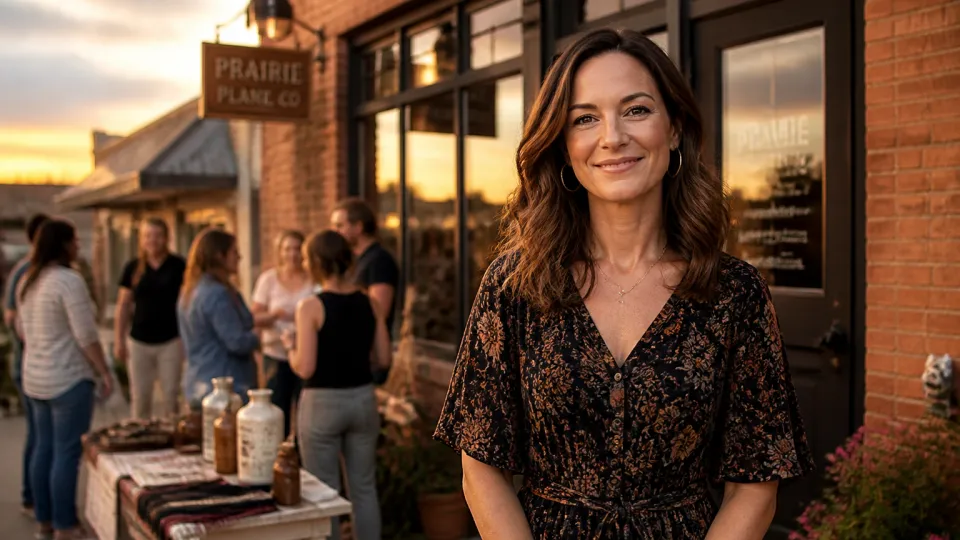
At six on a crisp October morning, Emma LaRue unlocks the front door of a narrow brick storefront on Brandon’s downtown corridor and breathes in the quiet between deliveries. The space, once a sleepy corner of Main Street, now hums with the measured energy of a place that wears many hats: a maker’s workshop, a training site, a pop-up market, a meeting place for seniors. She moves between a table of hand-stitched aprons, a shelf of preserved goods from neighbouring farms, and a small classroom where a young man tunes a sewing machine under fluorescent light. "You have to keep the door open," she says, laughing. "People come in because they sense someone is making something here. That’s how the rest follows."
LaRue returned to Brandon six years ago after a decade in Winnipeg and a short stint in Vancouver. Raised on a mixed grain farm outside of Neepawa, she had watched the slow erosion of services in the region: the corner store that closed, the bank branch that consolidated, the youth who left and didn’t come back. She came back not to nostalgia but to a practical question: what does a small town need to be worth staying in? Her answer, built incrementally and sometimes tentatively, has been to create a place that ties commerce to capacity-building.
Her business, The Common Thread, started as a co-operative studio for textile artisans and expanded into something more distinctly civic. LaRue negotiated a short-term lease on a storefront that a developer had slated for renovation, bought used equipment, and recruited local retirees, recent immigrants, and college students to teach weekend workshops. "We set a price that would cover materials and pay the instructors—because a craft taught for free is still unpaid labor," she says. "We wanted dignity to be part of the model."
Within two years The Common Thread ran weekly youth sewing classes in partnership with Assiniboine College’s community outreach program, hosted a monthly farmers’ market on a side street, and created a microconsignment shelf where local producers could test products without high overhead. That shelf became an incubator: a honey producer who had only sold at roadside stands began fulfilling orders for three restaurants in Brandon; a former industrial worker trained in altered-clothing techniques started designing uniforms for a neighbouring childcare cooperative.
The economic effects are not dramatic in the sense of a factory opening, but they are cumulative and human. "It’s the small things that keep people here," says Mayor Janice Thomas, who remembers a time when downtown storefronts sat empty for months. "When someone like Emma takes a risk, rents a space, and brings people together, it changes the neighbourhood’s rhythm."
Beyond commerce, LaRue’s project has focused on filling gaps that public services no longer reliably cover. On weekday afternoons, The Common Thread becomes an informal hub for seniors attending knitting circles and a place where newcomers come for drop-in employment coaching. During the pandemic, LaRue converted half the space into a distribution point for locally made masks and coordinated deliveries to isolated elders. "Community resilience is messy and improvisational," she says. "Sometimes it’s about finding a van and making deliveries. Sometimes it’s about having soup when the heating fails."
Her approach is pragmatic: low margins, diversified activities, and partnerships. She secured a small municipal microloan to retrofit the space for accessibility and worked with a local philanthropic group to subsidize a stipend for instructors from low-income households. Those moves didn’t just keep the lights on; they made the enterprise visible as a shared resource, not a private boutique.
Not all experiments have succeeded. A café annex meant to provide work placement flopped when supply-chain pressures and rising costs made sustainable pricing impossible. "We learned that hospitality is its own beast," LaRue says. "It taught us to stick to our strengths and to be honest about what we can’t subsidize." This candor has engendered trust. People in town say she is willing to fail publicly and learn.
What sets LaRue apart is her sense of time. She measures success not in quarterly profits but in relationships and capabilities: the teenager who learned a trade and went on to an apprenticeship; the newcomer who felt welcome enough to open a small food stall; the downtown landlord who, seeing renewed foot traffic, opted for longer leases with local operators. "You can see the future in the people who turn up every week," she says. "That slow accretion is what actually changes a place."
Looking ahead, LaRue aims to formalize a mentorship network connecting Brandon’s small-business owners with rural entrepreneurs across Westman. She is exploring a mobile workshop to travel to smaller towns that lack space for training. "We can be a small-city anchor and a regional resource," she says. "But we have to build systems that outlast any one of us."
Her story is not a model of heroic singularity but of modest, iterative community-building. In regions where public investment is uneven and capital scarce, often means knitting the social fabric at the same time as the economic one. LaRue’s work is a reminder that rural revitalization is frequently a matter of patient craft: a storefront turned studio, a few jobs created, a cohort of new makers trained—and the slow restoration of a town’s ability to imagine staying.
On a Saturday afternoon, a crowd crowds the sidewalk for a market day. Children chase each other past a mural that local artists painted last summer. LaRue stands in the doorway, sleeves dusted with fabric dye, and watches. "I don’t want to romanticize it," she says. "It’s a lot of hard, boring work. But when somebody tells you they stayed because of what we built, that’s the ledger that matters."