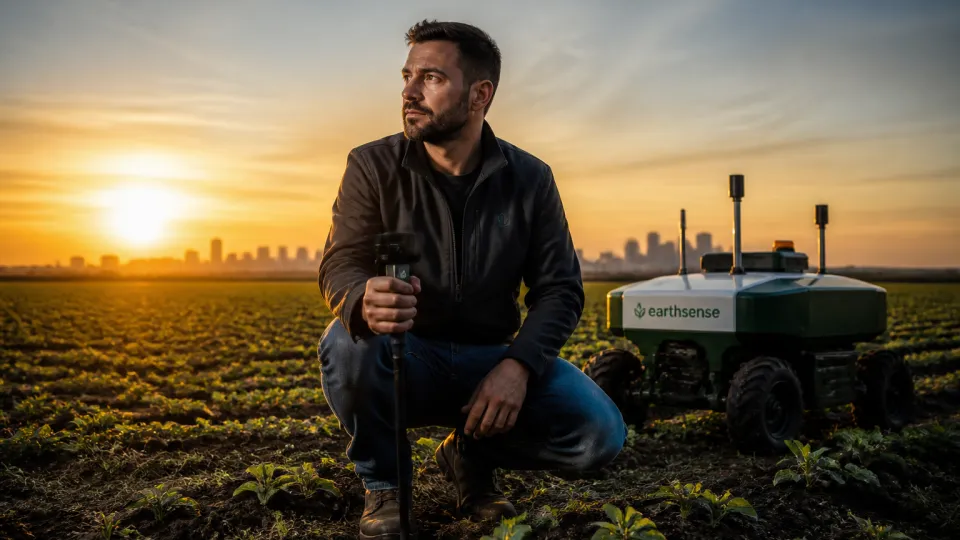
At dawn, when the air over the Brandon plains is still and the combines are silent, Maya Sutherland walks a field that has been in cultivation for generations. She crouches to press a slim probe into the black loam, watching a small LED pulse on the side of the device. The light sends data through a low-power radio to a weathered trailer that hums like a distant heart. For farmers who have read weather in the sky for decades, this is another language—one Sutherland is teaching them to speak.
Sutherland, forty-two, grew up outside of Brandon on a mixed grain and cattle farm. She learned to lift grain bags and patch fences, but she also kept a notebook of patterns: which parts of the field held water longer, which low knolls froze earlier in spring. After studying agricultural systems and engineering on scholarship, she returned to Westman with a conviction that should be built around local know-how, not replace it.
"We haven't lost the intuition here," Sutherland told me in a quiet office above a mechanic's shop where her company, Prairie Logic, installs servers and maps fields. "What we can do is give farmers information they can act on, without asking them to become computer scientists."
Prairie Logic’s work sits at the intersection of three threads: affordable hardware, open data, and shared service models. The company deploys a mesh of soil moisture and temperature sensors on participating farms, paired with inexpensive weather stations. The devices are designed for prairie conditions—rugged, repairable, and networked over long-range radios that can span tens of kilometers.
But the is only half the story. Sutherland has eschewed direct sales in favor of a cooperative rental scheme. Farmers sign up for a seasonal service: Prairie Logic installs sensors, collects and analyzes the data, and provides weekly, field-specific recommendations on seeding depth, fertilizer timing, and irrigation where appropriate. Local technicians—many hired from the Brandon area—maintain the networks and teach farmers how to interpret the reports.
The results are practical rather than headline-grabbing. In trials last summer across six demonstration farms between Brandon and Rivers, participants reported reductions in nitrogen applications of roughly 15 to 20 percent without measurable yield loss. One farmer, Tom Reimer, who grows canola and wheat near Rivers, described the change as "less guesswork and more confidence." Reimer's fields have long patches that look identical from a tractor seat but behave differently; sensor maps let him vary input by zone instead of by gut.
Sutherland is careful about the numbers and impatient with overpromising. "This isn't magic," she said. "It's reconnaissance. It's knowing where to spend, and where not to." Her team documents costs and yields meticulously; the goal is to show a clear return on investment for farmers with thin margins.
Beyond the agronomic gains, Prairie Logic has become a small but meaningful employer in Westman. The company employs a handful of full-time technicians and several seasonal workers drawn from nearby trades and community college programs. Sutherland established an apprenticeship partnership with a local training center that teaches sensor maintenance, radio network installation, and basic data interpretation—skills that are portable and in demand as agricultural systems digitize.
"It's changed how young people see opportunities here," said Sarah Desjardins, a program instructor. "You can stay in Westman and build a career working with technology on the land you know."
The human dimension matters to Sutherland in another way: trust. Early adoption in rural communities depends on credible neighbors and transparent accounting. Sutherland runs open field days, publishes raw datasets for local researchers, and invites skeptical farmers to ride along during installations. Those gestures have turned curiosity into collaboration.
There are limits and tensions. Connectivity remains patchy in many parts of Westman; while a single mesh network can cover several farms, infrastructure investments—cell towers, fiber—still dictate where higher-resolution services are practical. The capital cost of robotics and automated equipment remains a barrier for smaller operations, even when rental models lower the threshold. And climate change, which Sutherland lists as the primary long-term challenge, complicates the calculus: more frequent spring floods and erratic precipitation undermine assumptions about rotation and input timing.
Sutherland's response is incremental and pragmatic. She is piloting a shared-ownership model for small autonomous weeders and plans to test cooperative insurance products—data-backed policies that pay out based on field metrics rather than broad, county-wide indicators. She is also exploring collaborations with researchers at Brandon University to study long-term soil health impacts and with local extension services to scale training.
What emerges from Sutherland’s work is less a singular technological breakthrough than a model for community-centered innovation: tools adapted to place, services designed around people, and an eye toward shared risk. The devices she deploys do not replace experience; they amplify it.
On a warm evening in late August, as the sun slipped behind the flat horizon, farmers gathered at a demonstration site to look at maps and talk about the coming harvest. A teenage apprentice explained how a particular sensor array had detected a dry patch the month before, allowing a split application that likely saved a stand. The conversation was casual—practical observations, jokes, notes about cattle—but there was a steady undercurrent of what the data might make possible: steadier incomes, fewer chemicals, and jobs that keep young people close to home.
Standing in that circle, Sutherland watched without much fanfare. "This region is stubborn in the best of ways," she said. "People here care about the ground under their feet. If we help them care for it with information, that will outlast any single technology."
Her ambition is modest and long. In a landscape where seasons and markets remain unpredictable, the work she and her community are doing is about building a form of resilience that is both technical and human, stitched into the routines of barns and kitchens across Westman.