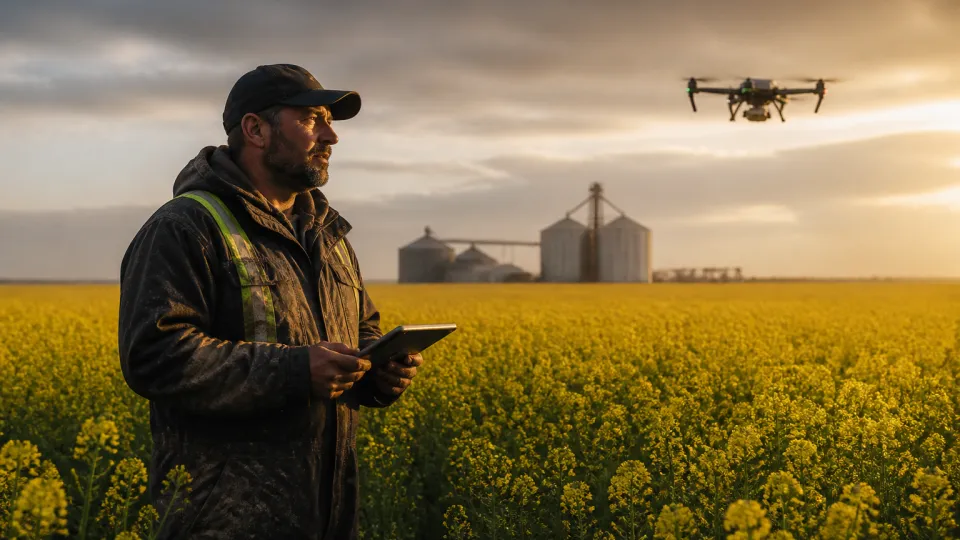
This scene repeats in variations across Westman. Brandon's grain elevators and the patchwork of family farms that fan outward from the city now share airspace with unassuming devices: sensors sunk into loam, tractors steered by GPS, and swarms of low-flying drones. Beneath the optics and algorithms, however, lies a more human story — of intergenerational knowledge being reassembled, of community risk being pooled, and of a region reckoning with climate volatility while trying to keep its social fabric intact.
Technological adoption here has not been an onslaught but a conversation. Farmers I spoke with described incremental shifts: a neighbour who tried variable-rate fertilizer two years ago and cut costs; a youth-run start-up in Brandon that helps small co-ops interpret their soil data; a handful of producers in Carberry who pooled resources to buy a communal drying unit. The pace and shape of change, locals say, reflect local priorities — financial resilience, land stewardship, and the continuity of community life.
"We aren't just chasing the newest gadget," said a fourth-generation producer near Minnedosa. "We're trying to decide what actually helps the farm survive when spring is weird and storms come early. If it doesn't help my neighbour, it's not worth it to me."
Two trends converge here. The first is precision agriculture: tools that measure — not guess — what the land needs. Soil moisture probes send hourly data. Satellite imagery, combined with on-the-ground sensors, allows farmers to map variability in a field and adjust inputs accordingly. That precise tailoring reduces fertilizer use and saves money, yes, but farmers also report a different gain: a sense of control in a time of climatic surprise.
The second trend is regenerative practice. Across Westman, conversations at co-op meetings and community halls have shifted from yield maximization alone to soil-building strategies: cover cropping, reduced tillage, and the reintroduction of diverse crop rotations. These approaches are not driven by novelty but necessity. Winters are shorter, precipitation arrives in more extreme bursts, and soil that once absorbed spring runoff now sometimes does not. Regenerative methods aim to restore the land’s buffering capacity.
Those two currents — high-tech sensing and low-tech soil care — are not opposites here; they are being braided together. In Glenwood and beyond, farmers use sensors to identify zones most in need of cover crops. Drones detect early signs of disease, allowing targeted, smaller interventions. Local research stations, including the Brandon Research Centre, have become nodes in this network, translating experimental plots into pragmatic advice.
Adoption comes with social costs and benefits. Young people returning to the region find meaningful work translating data into practice, starting small consultancies that teach neighbours how to read a moisture map or set up a variable-rate seeder. Several local entrepreneurs have launched service models that let smaller farms access expensive tools — drones-as-a-service, data analysis by the hour — avoiding burdensome capital outlays.
But there's friction. Older producers sometimes see new language — "analytics," "carbon credits," "regenerative certification" — as distracting. The initial investments remain prohibitive without collective action. And there is a psychic dimension: handing some decisions to software can feel like ceding an old, embodied expertise.
Still, community responses have been robust. Cooperative grain elevators have been repurposed as informal learning hubs; high school ag classes in Brandon now include soil health modules; and weekly coffee-shop conversations about the price of canola have migrated to technical forums where GPS maps are compared like hockey scores. These shifts alter not just balance sheets but relationships: shared equipment leads to shared responsibility, and shared responsibility tends to produce new social ties.
Looking forward, the region's resilience will depend on policy and partnerships that recognize the hybrid nature of this transition. Subsidies and grants that once rewarded scale must be redesigned to reward stewardship and access. Investment in rural broadband is not a luxury but infrastructure that converts sensors into practical knowledge. And perhaps most important, local institutions — universities, research stations, co-ops, and municipal governments — will need to scaffold experimentation so risk is communal rather than individual.
The story of Westman's agricultural is not a triumphalist tale of sweeping away old ways. It is quieter and more consequential: neighbours learning to translate satellite data into winter feed plans; young entrepreneurs breathing new life into town economies; seasoned farmers marrying intuition with metrics. As one producer said while watching a drone land, "It's still my land. Now I just have better tools to keep it alive for the next person." That modest ambition — to sustain land and community together — may be the most radical innovation of all.