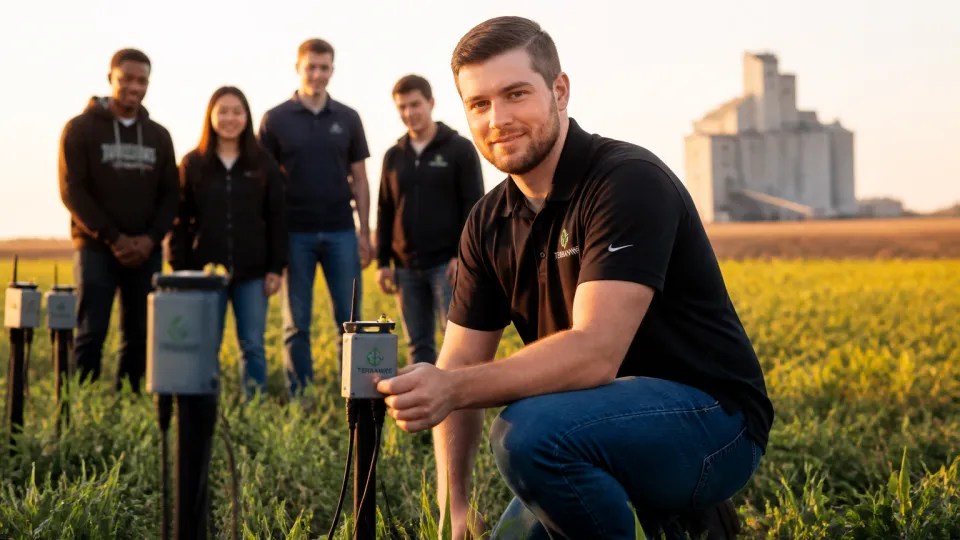
On a cold, thawing morning outside Brandon, a string of tiny black nodes blinked like solemn fireflies across a quarter-section of wheat. They were the size of a matchbox, mounted on short stakes, recording moisture and temperature, whispering their readings over low-power radio to a battered laptop in the back of a pickup. That pick-up belonged to Dani Reimer, who has spent the last six years converting childhood familiarity with family fields into a pragmatic experiment: can affordable change the economics and ethics of prairie farming?
Reimer grew up west of Brandon, the daughter of a mixed-grain family that rotated canola and pulses, hauled seed in winter and worried about commodity prices in summer. She left for a degree in environmental science, watched large agtech systems take root in university labs, and returned convinced that the real barrier wasn’t possibility but accessibility. Proprietary sensor packages and subscription platforms were priced for large operations and corporate farms; smaller producers in Westman either adapted other tools or made decisions blind.
So she founded Prairie Sense Labs, a company that stitches together low-cost hardware, open-source software, and a service ethos that fits the prairie. Her team designs simple soil sensors, pairs them with an app that maps moisture and nitrogen trends, and—crucially—comes to the farm to install, calibrate, and teach. The product is less glamorous than a flashy drone, but its effect has been quietly revolutionary for several local operators.
'We wanted something that could actually be fixed on a Sunday at the co-op,' Reimer tells me as she knuckles frost out of the battery housing of a sensor. 'If a node fails, a farmer shouldn't have to call a technician from Winnipeg and wait a week.'
The practicalism shows in specific outcomes. On a pilot parcel near Wawanesa, a farmer named Harold McIntyre used Prairie Sense nodes through a spring that was erratically wet and then dry. The granular data allowed him to delay a blanket fertilizer application until soils were warm and moisture levels could retain nitrogen. The result, by Reimer’s account and Harold’s ledger, was about a quarter less nitrogen used that season without sacrificing yields—and a smaller bill for fertilizer.
'It’s not magic,' Harold says, stirring coffee under the truck’s canopy. 'It’s just knowing what’s actually in the ground. That’s worth money and it’s worth sleep.'
For Westman’s smallholders, the impact is not only economic. Reimer frames the work as an act of stewardship. The prairies have long borne the weight of commodity pressure and now face a changing climate: more extreme precipitation, sometimes late freezes, and the slow creep of saline pockets. Sensors that translate soil into readable decisions have helped several farmers adopt more precise seeding and nutrient regimes, which often reduces runoff and improves soil structure.
Beyond the devices, Prairie Sense Labs has become a training ground. Reimer runs a summer internship program in partnership with a local college, where students help install arrays and interpret data for producers. One alumnus now runs the company’s field ops; another started a soil-conservation cooperative that rents equipment across municipal boundaries. These ripple effects—new jobs, retained youth, and shared tools—are as consequential as the numbers on an app.
There are obstacles. Wireless coverage across the prairie is patchy. Extreme weather can still damage hardware. And there is cultural friction: some older farmers distrust data that isn’t their own judgement. Reimer meets that resistance by staying in the field, literally, and by translating figures into practices that make sense for a specific operation. When a sensor shows persistent dryness at 30 cm depth, she doesn’t hand farmers a chart—she helps them plan a localized tweak to seeding depth or a pivot in crop selection.
The firm’s business model is lean and locally minded: modest hardware margins subsidize training and an open-data stance that lets farmers download their own records. That approach has attracted informal interest from regional co-ops and from municipal governments looking for cost-effective tools to monitor watershed health. Reimer is cautious about scaling too fast; her concern is not market share but maintainability. In her telling, the measure of success is whether a farmer on the Souris plains can fix a sensor after a storm and whether a high-school grad can read the data the next season.
Looking ahead, Reimer imagines networks of modest sensors providing a different kind of prairie resilience. Aggregated, anonymized data could inform municipal decisions on drainage and seeding advice. Local grain elevators might use trend lines to better predict storage demands. And for the young people she employs, the work offers a new vocational horizon: technology rooted in place.
Her ambition is not to outpace existing agtech but to reframe it. 'We’re not selling a dream of perfect prediction,' she says. 'We’re selling better chances—better timing, fewer wasteful inputs, and more money staying in town.'
Back at the pickup, beneath a sky the colour of pewter, the sensors continue to blink. They are small interventions—unflashy and weatherproof—and they are beginning, quietly, to rearrange how decisions are made across the prairie. In a region that has long measured success in bushels and bank reconciliations, Prairie Sense Labs offers another ledger: the health of soil, the security of a farmer’s income, and a community learning to read the land with an instrument that fits in a pocket.