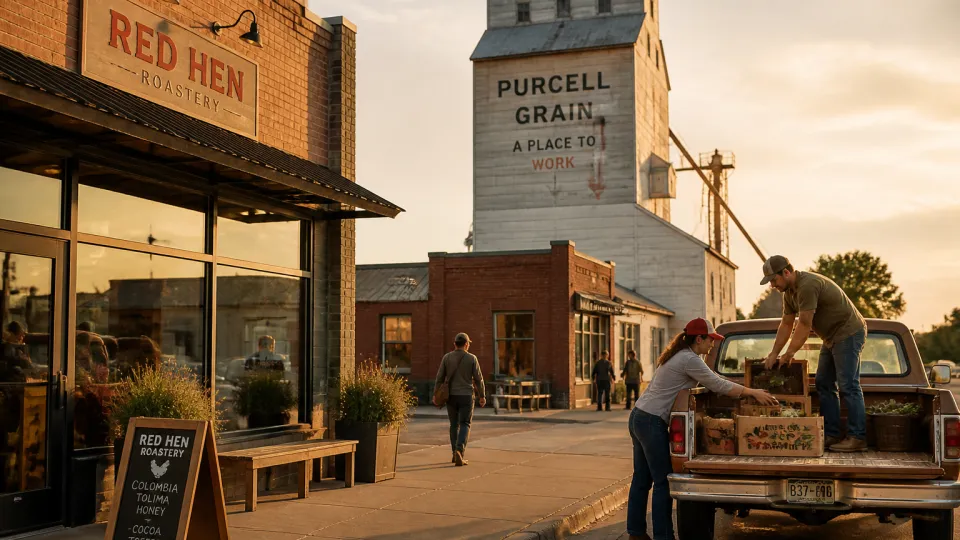
On a cold Tuesday morning in downtown Brandon, the air deepens with two scents: fresh espresso and sawdust. Maya Singh grinds a single-origin bean in her narrow roasting room while a contractor outside measures boards for an expansion that will double her retail space. It is an ordinary, stubbornly practical scene—orders, invoices, permits—but beneath it is a quieter story about what it means to build something durable in Westman.
Singh moved back to Brandon five years ago after studying food science in Winnipeg. She opened a micro-roastery because she wanted a business that married craftsmanship with place. ‘‘People come in and tell me which farm their grandparents came from,’’ she says. ‘‘They want a coffee that tastes like where they live, not something shipped in from a distribution center.’’ Her roast pays rent, but its value is measured less in margins than in the morning conversations she now hosts: a retired teacher mentoring a high-school student on resumes, a local nurse unwinding at the bar on a night shift.
Across town, in a low-slung industrial building near the railway, Ethan and Claire Martin calibrate sensors that monitor soil moisture and nitrogen levels for family farms. Their company began as a kitchen-table experiment—Ethan’s father was losing patience with fertilizer runoff and inconsistent yields—but it has become a practical example of rural-born . ‘‘We don’t want to replace the farmer,’’ Claire says. ‘‘We want to give them better information so decisions are local, precise, and less wasteful.’’ Their hardware is designed to survive hard winters and be affordable for 80-acre operations, not just corporate farms.
These are not isolated anecdotes but part of a pattern: entrepreneurs drawing on local knowledge and relationships to create businesses tuned to rural rhythms. In small towns from Neepawa to Virden, new ventures are less about flashy exits and more about layered resilience. There’s a social bakery in Virden that trains recent immigrants in commercial baking and supplies the town’s grocery store. There’s a makerspace in Carberry housed in a converted elevator where woodworkers and coders share tools and internet bandwidth. A weekly farmers’ market in a tiny hamlet now functions as a clearinghouse for value-added products—pickles, preserves, artisan bread—that allow producers to keep a larger share of retail value.
Two forces make these projects possible. First, improved connectivity: when reliable broadband arrived in pockets across Westman, it didn’t instantly cure decline, but it lowered the cost of participation. An ag-tech startup can send firmware updates overnight; a seamstress can sell heirloom-quality garments to Vancouver customers; a co-op can process orders and publish stories about provenance. Second, institutional bridges—Brandon University, community foundations, and local lenders—are beginning to think beyond grants and loans, offering mentorship, shared facilities, and patient capital. ‘‘Capital without context is noise,’’ one local lender told me; in Westman, money tends to function as accompaniment, not fuel for speculative growth.
There are tensions. Hiring is hard when many young people still drift to larger cities. Access to scale is inconsistent: a bakery can succeed in its town but struggle to reach neighboring markets without a cold chain or logistics partner. Mental health and burnout lurk behind countless kitchen lights and late-night coding sessions. Entrepreneurs in rural places carry responsibilities that would be unconscionable in denser markets—a storefront owner is often also the de facto chamber-of-commerce volunteer, a fundraiser, and a municipal advocate.
Yet those responsibilities can be an asset. Entrepreneurs here say the social economy—neighbors spreading the word, a volunteer sanding tables on a slow Sunday—reduces customer-acquisition costs and builds a currency of trust. ‘‘We are embedded,’’ says Singh. ‘‘Our reputations run on a small-town ledger. That keeps us honest and creative.’’
Looking ahead, the most promising ventures are those that fold scale into locality. Martin’s sensors are being bundled into community leases so smaller farms can subscribe without heavy upfront costs. The bakery partners with a regional food hub to distribute to schools and care homes, stabilizing demand through institutional contracts. Co-working hubs are experimenting with a rotating residency model that brings in specialists—marketing, food safety, soil science—so entrepreneurs gain episodic expertise without permanent overhead.
Policy choices will matter. Investment in training, flexible financing designed for seasonal revenues, and thoughtful broadband deployment remain critical. But so do softer supports: a regional narrative that values iterative, place-rooted rather than celebrating only rapid unicorn-style growth. In Westman, startups look like bakeries and sensor companies and roasteries because the economy here is a patchwork quilt; successful patches keep each other from fraying.
What emerges is not a triumphalist portrait but a long, collective experiment in reimagining rural possibility. The next ten years will belong to the entrepreneurs who see Westman not as a deficit to be overcome but as a platform—finite in population but rich in connection, history, and obligation. ‘‘We are not trying to become the city,’’ Singh says as she pulls another bag of beans from the cooler. ‘‘We’re trying to make something that can stay here, pay people fairly, and make life better for our neighbors. That is ambitious in its own way."