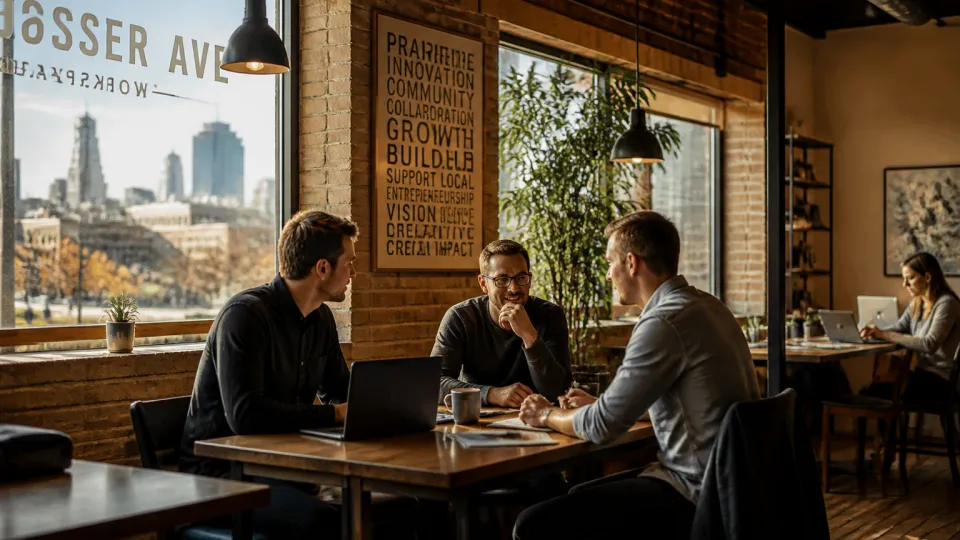
On a cold spring morning, sunlight slices through the tall windows of a converted storefront on Rosser Avenue. A pair of laptops glow on a communal table. A grandmother who once ran a roadside produce stall is sketching labels for a line of fermented foods; across from her, a young software developer edits code for a farm-management app. Outside, the Assiniboine River moves with an old patience. Inside, there is a sense of something being remade.
That scene — a downtown co-working space that looks and feels like a neighborhood living room — is not an anomaly in Brandon and the towns that dot Manitoba’s Westman region. Over the past decade a cluster of modest but determined ventures — value-added ag businesses, creative studios, service enterprises, and tech ventures adapted to prairie life — have begun to reweave the economic and social fabric of small towns. The work is incremental, pragmatic and stubbornly local, and its consequences extend beyond profit margins.
At the heart of the region’s energy is an argument long familiar to rural scholars: diversification. Where previous generations saw the farm or the small-town main street as fragile and finite, new entrepreneurs see opportunity in reimagining existing assets. Grain, for instance, has become more than a bulk commodity. Farmers and processors around Neepawa and Carberry are experimenting with on-farm processing, artisanal bakeries and specialty oil pressing, turning seasons of abundance into year-round employment. These ventures keep dollars circulating locally while creating identities — "Made in Westman" is both a brand and a civic ritual.
The human stories are revealing. One founder, who returned to Brandon after a decade in Winnipeg, described the gravitational pull of family and place. "I wanted my kids to grow up where we have space — but I also wanted to make something that matters," she told me. She makes preserves from local fruit, but her business’s real is in : she hires students, offers apprenticeship on the farm, and uses the storefront as a meeting place for seniors. The result is less a scaled tech unicorn and more a durable node of work and care.
Institutions matter. Brandon University’s Rural Development Institute has been a quiet but important presence, translating research into practice and connecting local leaders to policy conversations. Community colleges and vocational programs in the region are training people in food safety, digital marketing and small-scale manufacturing — skills essential to entrepreneurs who must be both craftsperson and chief executive. Municipal economic development offices have shifted from handing out tax incentives to brokering partnerships: access to shared commercial kitchen spaces, assistance with regulatory navigation, and introductions to sympathetic lenders who understand seasonal cash flows.
Connectivity — digital and social — is the new infrastructure. Improved broadband has lowered the friction for remote work and enabled farm-management software, e-commerce, and virtual consulting. But connectivity remains uneven across the region, and entrepreneurs often mention it as the single biggest constraint to growth. A developer in Virden told me he can sell to customers across Canada, but inconsistent upload speeds make client calls impossible at times. The is generative, but only when the underlying networks are reliable.
Economic impact here is intimate rather than headline-hitting. A handmade furniture studio in Souris employs three apprentices and contracts with the local high school for woodshop internships; a cooperative poultry processor near Carberry made it possible for three family farms to scale without losing control over their animals; a social enterprise in Brandon provides transitional employment for newcomers and, in doing so, expands the local labour pool. Each enterprise may add only a handful of jobs, but cumulatively they change how a town functions: more evening activity downtown, fewer empty storefronts, more opportunities for young people to stay or return.
There are trade-offs, and not all experiments succeed. Some ventures fail because the market turns or because founders underestimate the cost of scaling. Others reveal deeper structural issues: lack of affordable housing for employees, limited public transit, or regulatory frameworks designed for larger, urban firms. These realities force a different kind of ingenuity — collaborative approaches to housing, shared logistics cooperatives for farm goods, and municipal procurement policies that prefer local suppliers.
Looking forward, the region’s most promising strategy may be its humility. Westman’s entrepreneurs are not trying to mimic Toronto or Vancouver; they are leveraging what they have: land, a culture of mutual aid, lower overheads, and a willingness to learn across generations. Policy could accelerate this by directing patient capital into microloan funds, strengthening digital infrastructure, and supporting incubator spaces that combine production and mentorship.
The stakes are cultural as much as economic. in Westman is knitting together identities — migrant, Indigenous, long-settled — around new kinds of work. It is changing the rhythms of towns, creating more ways to belong. In a region where distance used to signal scarcity, distance is becoming an asset: a place with room to experiment, to fail, and to try again. The co-working space on Rosser Avenue is a modest theater for that ambition; so are the kitchens and workshops across prairie towns. Together they point to a rural future that resists nostalgia and builds, patiently and practically, a renewed sense of home.