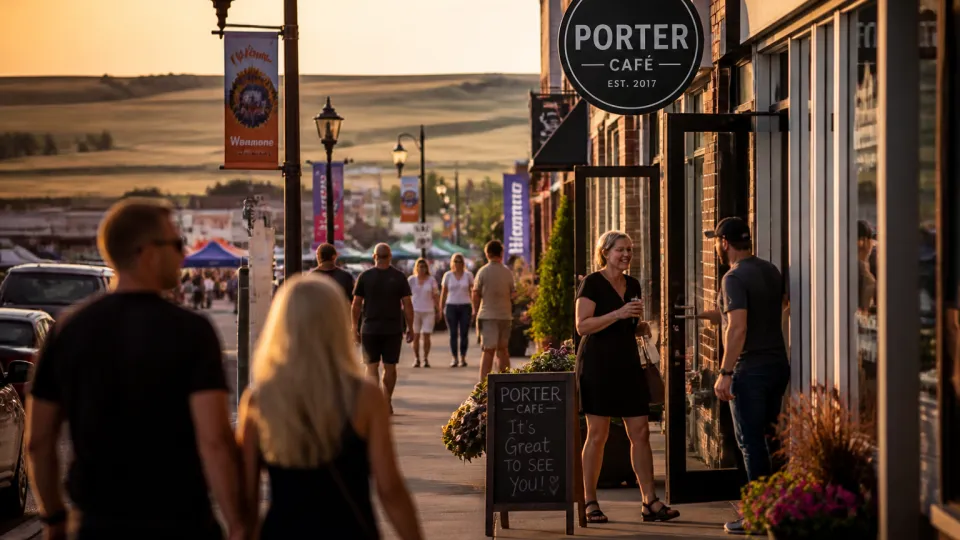
On a January morning in downtown Brandon, the lights of Prairie Thread Café come on before most other storefronts. Owner Maya Singh unlocks the front door, flips the sign to "Open," and begins the quiet work most customers never see: kneading dough, calibrating the espresso, arranging chairs so that the late–afternoon book club has a place to gather. Eight years ago, Singh returned to Brandon after a decade away. "I wanted a place that felt like home," she told me. "But I also wanted to make a living that stayed here, not somewhere else." What she built is part coffee shop, part hub, and part incubator for other small ventures — a pattern now familiar across Westman.
Singh's café serves as an entry point to a larger story: entrepreneurs in rural Manitoba are reimagining what it means to run a business outside big cities. They're not just surviving; they're changing the texture of town life — preserving storefronts, training workers, and creating social routines that glue communities together.
A few towns over, in Neepawa, Lena and Aaron Thompson converted an old grain elevator office into Prairie Acre Distillery. Where once farmers simply sold barley, the Thompsons now bottle slender-necked spirits that tourists sample on summer weekends. "We want people to think differently about where products come from," Lena said. "You leave with a bottle and a story about the field it came from." The distillery hasn't made Neepawa a boomtown, but it has created employment for local youth, provided a reason for weekend visitors to linger, and strengthened the market for local barley.
In Carberry, a different experiment is underway. Seed & Circuit is a small maker-space and light-manufacturing shop run by former high school teacher Elliot Ramirez. Fusing digital fabrication with practical problem-solving, the shop produces repair parts for farm equipment and offers trainings in CAD and CNC operation. Ramirez's apprentices are often young people who might otherwise have left for larger centres. "We teach them skills that pay a dozen ways," he said. "They're fabricating parts one day, then helping a neighbour fix a tractor the next."
These businesses are distinct in product and scale, but they share a trait: an orientation toward place. Each enterprise leverages a local asset — crops, human capital, or a historic building — and in doing so generates ripple effects that standard economic analyses sometimes miss.
The human elements are where impact becomes visible. At Prairie Thread, an after-school program partners with a nearby settlement agency to employ newcomers learning English; at Prairie Acre, farmers' co-ops negotiate small-batch contracts that pay premiums for traceability; at Seed & Circuit, youth who once contemplated migration find reasons to build futures here.
"It's about more than jobs," said Kathleen Morris, director of a regional community foundation. "New businesses bring routines, mentorships, and expectations. When the bakery is open, people meet. When a distillery hosts a tasting, downtown vibrates. That social capital is part of resilience."
Yet building these businesses hasn't been easy. Entrepreneurs cited common obstacles: access to capital beyond family loans, shortages of skilled labour, limited broadband in some pockets, and bureaucratic friction around zoning and licensing. "We improvised a lot," Lena Thompson admitted. "There were nights we didn't know where the next customer would come from. But the town showed up." That reciprocity — residents choosing local goods and volunteering time — reduces the financial risk businesses face and accelerates their ability to sustain operations.
One of the most striking shifts is the culture of collaboration. Chambers of commerce, municipal governments, and post-secondary institutions in Westman have started to coordinate with entrepreneurs rather than merely regulating them. Brandon University now hosts clinics that pair business students with rural startups; municipal procurement policies in a few towns increasingly favor local suppliers. These adjustments are small but meaningful: they create pathways for scale without demanding entrepreneurs abandon local identity.
The role of digital platforms is equally pragmatic. For many retailers and makers, e-commerce extends market reach beyond provincial borders. For manufacturers like Seed & Circuit, online marketplaces for custom parts let small-batch production become viable. But is a tool, not a solution: it magnifies opportunity when paired with local knowledge.
The future of in Westman will depend on policies that recognize rural specificity. Broadband access, targeted financing that understands seasonal cash flows, and skills training tied to regional industries will matter. More than infrastructure, though, communities will need to sustain the informal networks that make a town hospitable: mentors who lend equipment, neighbours who promote businesses on social media, local leaders who prioritize downtown vibrancy.
Back at Prairie Thread, as afternoon light slants through frosted windows, Singh rehearses a partnership with the theatre company across the street: a pop-up during opening nights to serve the audience and create a sense of ritual. "If we can embed our businesses into the life people already love," she said, "then economic development becomes everyday life."
That pragmatic intimacy — business woven into social fabric — is the quiet revolution unfolding across Westman. It is not a flash of urban-style disruption but a patient practice: entrepreneurs inventing livelihoods that keep skills, stories, and relationships local, even as they look outward. For small towns seeking , that balance may be the most promising model of all.