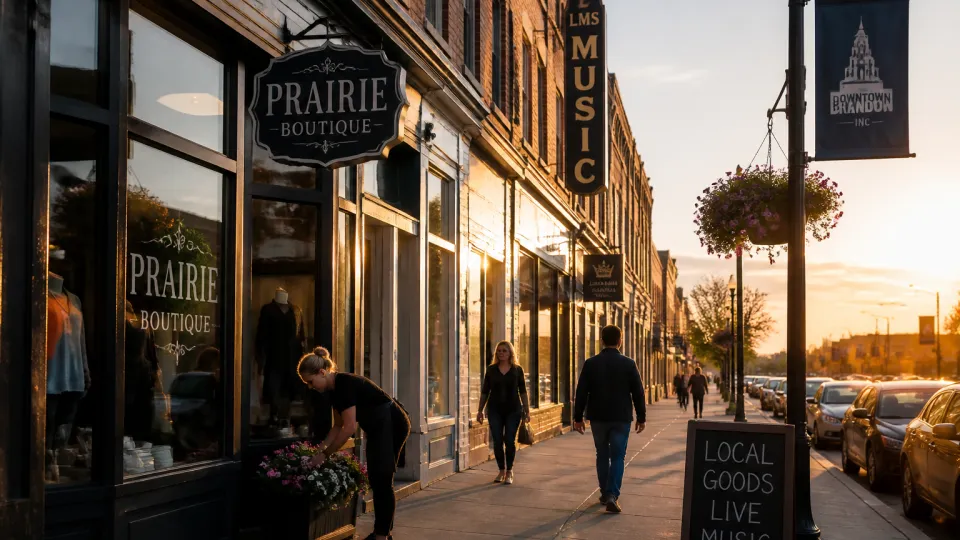
The sun lifts over Brandon and the prairie feels like an old photograph brought back into motion: long light, clean air, and storefronts opening with familiar routines. But behind those familiar façades something new is being stitched into the town’s daily life. A roastery fires up in a converted garage; a software team meets in a repurposed grain elevator; a neighbourhood co-op folds fresh produce into a social enterprise. In small towns across Westman, is less an abstract policy goal than a set of daily negotiations between place, history, and people.
It’s easy to imagine entrepreneurs only as risk-takers chasing outsize returns. In Westman they arrive with the more modest, and in many ways harder, ambitions of making a living where they live and giving neighbours reasons to stay. That orientation changes what a business looks like and how success is measured.
Take Riverbend Coffee, a micro-roaster that opened three years ago on Princess Avenue. Its founder, Aisha Khan, moved from Winnipeg after her partner took a teaching job in Brandon. Khan remembers the calculus: ‘‘I didn’t want to commute to a job I loved; I wanted to build one here that fit our life.’’
Khan’s business is small by any metropolitan standard — two full-time staff, a handful of part-timers, and relationships with three local farms for seasonal pastries — but its impact is measured differently. The roastery pays above the local minimum wage, offers evening shifts to students, and partners with a newcomer settlement service to provide on-the-job training. When Riverbend began hosting evening entrepreneurship nights, attendance drew not only coffee enthusiasts but people with ideas: a retired mechanic tinkering with a prototype for a low-cost irrigation controller, a chef testing a prairie-foraged preserves line, a local teacher experimenting with a pop-up bookstore.
A few kilometres west, in a town where agriculture still anchors daily life, a small ag-tech firm called Prairie Logic has been prototyping sensors that help growers monitor soil moisture in microplots. Founder Evan Leclerc says the firm began as a response to direct conversations with neighbours. ‘‘Farmers here aren’t interested in gadgets for the sake of gadgets,’’ he told me. ‘‘They want something that saves time, reduces inputs, and fits the size of their operation.’’ By building with local growers and keeping development cycles short, Prairie Logic has iterated toward a product that could never have emerged in a coastal startup incubator.
What these stories share is an attention to relationships. Small ventures in Westman succeed because they are embedded in social networks that supply labour, mentorship, shared customers, and emotional scaffolding. That social capital is often invisible to outsiders but palpable to anyone who has watched a shopkeeper barter a credit line with a supplier to keep staff employed through a slow month.
Anna Petrov, who runs a crafts cooperative in Neepawa, sees entrepreneurship as a civic act. ‘‘We make income, yes, but we also make ,’’ she said, tucking a hand-woven blanket into a parcel bound for a customer in Regina. Her co-op hosts classes, pays local artists, and uses its storefront to display public notices. ‘‘When artists have an outlet, other people come to town to see them. That foot traffic supports the bakery and the feed store. It’s all connected.’’
Those connections matter when shocks arrive. During supply disruptions and labour shortages in the past two years, many Westman businesses survived because of informal sharing — equipment loans, delivery co-ops, or shared marketing platforms. These are not romantic anecdotes; they are practical risk-management strategies that reduce overhead and preserve local jobs.
The path is not smooth. Access to early-stage capital remains a persistent obstacle. Many lenders still view rural ventures as too small or too idiosyncratic for conventional financing. Broadband gaps, while narrowing, still limit remote work and product distribution for some enterprises. Finding skilled staff is often a balancing act between recruiting locally and persuading people to relocate.
Yet solutions are emerging from within the region’s own ecosystem. Shared workspaces in Brandon double as mentorship hubs. A rural makerspace in Minnedosa provides access to CNC machines and marketing workshops. Local procurement policies in several municipalities now prioritize small, local bidders for catering and construction contracts — small gestures that translate to predictable revenue for fledgling firms.
The future of entrepreneurship in Westman will be determined by how well communities hold two things in tension: the desire to scale and the discipline to remain rooted. Scaling can mean exporting expertise — a software tool for ag management developed in Westman can be sold globally — but it can also mean deepening local supply chains and training programmes. Policies that invest in broadband infrastructure, microcredit tailored to place-based enterprises, and civic procurement can multiply the returns of local ingenuity.
More than anything, sustaining entrepreneurship in rural Manitoba requires a redefinition of success. Not every business will become a regional unicorn, and that’s not a failure. Success here often looks like steady employment, apprentices who stay in town, and storefronts that animate main streets. It looks like the quiet exchange of labour and trust that keeps communities functioning.
For people in Westman, entrepreneurship is not a detour from community life but one of its main roads. The entrepreneurs I met are pragmatic people who prefer durable rhythms to flashy headlines, and through their small, persistent acts they are remaking what it means to belong to a place with a future. If the next decade brings better capital tools, improved connectivity, and more spaces to learn, those rhythms could become a blueprint for rural renewal elsewhere.