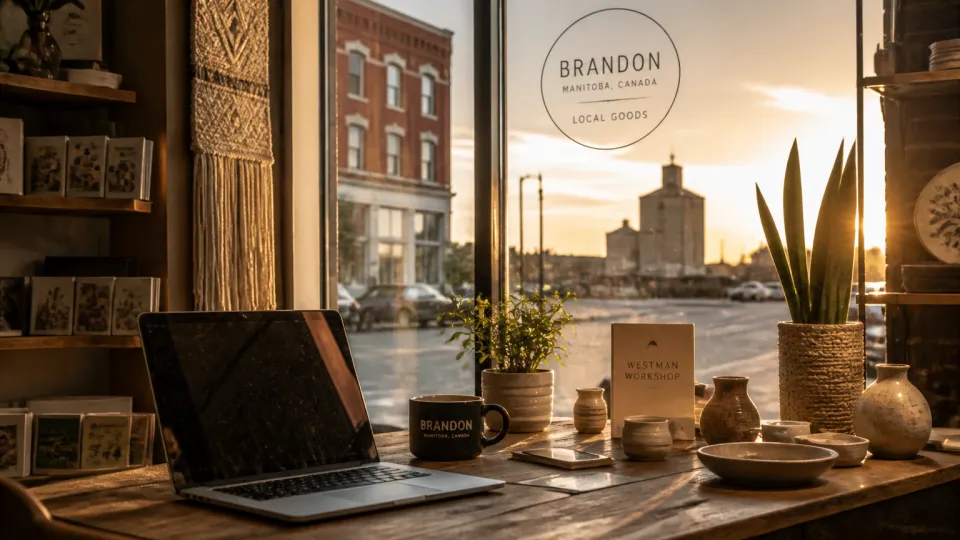
On a late spring morning in downtown Brandon, sunlight pools on the worn wooden floor of a former hardware store. A young woman adjusts studio lights beside racks of hand-stitched leather goods, while two programmers in the adjoining room debug a client’s website. The building smells faintly of coffee and new paint—a scent that, for many here, has come to signify a particular kind of possibility: the meeting of craft, code, and .
This is not an isolated vignette. Over the past five years, Brandon and neighbouring towns across Westman have seen an incremental but unmistakable shift. Farmers lease part of their barns to makers; retired teachers open co-working cafés; newcomers launch ethnic groceries and catering services that become informal cultural hubs. The rise of here is less about overnight tech unicorns than about a reweaving of local economies—layering onto existing social networks to produce businesses that are economically viable and socially embedded.
Take the example of Maya Singh, who returned to Brandon after a decade in Winnipeg to start a small digital studio. 'I could have stayed in the city and been anonymous,' she says, pouring tea into mismatched mugs. 'Here I know our clients, our postmaster, the person who runs the library. That context changes what I build.' Maya’s firm now serves regional agricultural cooperatives with tailored data visualizations that help farmers plan planting and marketing cycles—work that keeps money circulating locally.
In Minnedosa, fourth-generation farmer Ethan Clarke transformed underused land into a combined tasting room and agritourism space. He did not abandon commodity agriculture; instead, he diversified. 'Grain prices are a reality,' he explains, 'but offering workshops, a weekend market, and a small distillation project gives our family cash flow when the season is tough.' His venture employs seasonal workers, sources supplies within the region, and brings visitors who then spend money at nearby motels and cafés.
Immigrant entrepreneurs are also reshaping Main Streets. In Rivers, a modest storefront now houses a grocery and café where East African staples sit beside Mennonite preserves. The owner, Aisha Al-Mansour, sees her shop as part grocery, part community room. 'People come for the spices, but they also stay to practice English or to ask for help with forms,' she says. Her business underscores how entrepreneurship and social supports often arrive hand in hand in small-town settings.
These stories reveal patterns: businesses in Westman are hybrid—part cultural institution, part income generator. They rely on dense local relationships and on adaptive use of existing assets: a railway siding becomes a logistics node for artisanal goods, a library doubles as a workshop space after hours, a grain elevator hosts a pop-up market. This model is less glamorous than headline-grabbing startups, but it may be more durable in places where social capital outweighs access to venture capital.
Still, the path is not easy. Entrepreneurs steadily cite barriers: inconsistent broadband on outlying roads, limited childcare that constrains working hours, and difficulty accessing credit for nontraditional projects. 'Banks want collateral and predictable cash flows,' one local lender told me. 'Small, creative ventures often don’t fit that mould.' Housing shortages in Brandon—sparse rental listings and rising prices—also complicate hiring, particularly for young workers and newcomers.
Responses have been pragmatic and locally driven. A municipal partnership has repurposed vacant storefronts into short-term retail incubators; a credit union offers micro-loans with community-based guarantees; practice mentorship programs pair established business owners with first-time entrepreneurs. Informal networks—church groups, university alumni, farmers’ cooperatives—frequently substitute for formal infrastructure, providing apprenticeships and customer introductions that are hard to quantify but crucial in practice.
Institutions are waking up to the potential, too. Brandon’s university and community college are experimenting with applied programs that keep students locally engaged through placements with area businesses. Local governments are rethinking zoning and permitting to encourage mixed uses—allowing a bakery to operate above a shop or a farm to host events without onerous approvals.
Looking forward, the most promising developments are not single silver bullets but cumulative changes that lower the friction for new ventures. Expanding reliable broadband would multiply remote work opportunities and let rural creative and technical businesses scale beyond local markets. Flexible procurement policies at municipal and health-care institutions could direct more spending to local suppliers, creating reliable revenue streams. And targeted childcare and housing initiatives would make it possible for entrepreneurs—especially women and newcomers—to remain in the region while growing enterprises.
What binds these policy shifts is an appreciation for entrepreneurship not only as a source of income but as a civic practice. Small ventures in Westman are often places where public life happens: where a poetry reading follows a craft fair, where a parent meets a future employee. Entrepreneurship here stitches together economic and social resilience.
If the last decade taught one lesson, it is that rural places can incubate forms of business that urban models do not capture: businesses that trade on trust, local knowledge, and the long arc of community relationships. The future for Westman will hinge on how those strengths are amplified by infrastructure and institutions. In the storefront studio in Brandon, under soft light, a community is quietly recalibrating its own future—less with a single dramatic disruption than through a thousand incremental acts of making, trading, and caring.
'We aren’t trying to be something else,' Maya says, closing her laptop as customers drift in. 'We’re trying to make what we have last, and to make it better.'