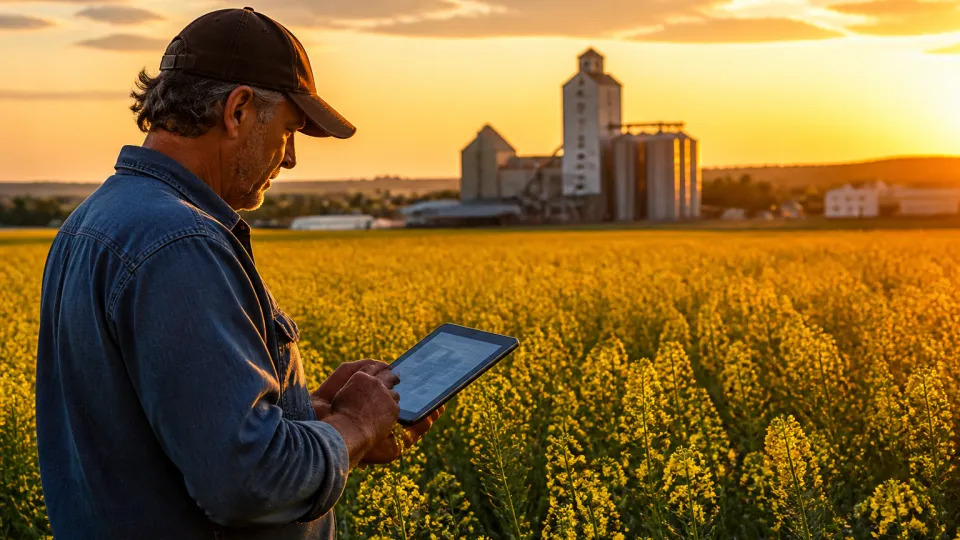
On an August morning just outside Neepawa, Tom Reynolds settles into the passenger seat of his pickup, not to chase a rabbit or check a fence line, but to watch a live feed of his sprayer's nozzle patterns on a tablet. He swipes, zooms, and taps commands; the machine in the next field responds a minute later. "I grew up with my father's wrench in my hand," Tom says, "but now I check maps more than engines. It saves time—and mistakes."
This image—hands that once mended metal now navigating software—captures a quiet revolution unfolding across Westman. From Brandon's downtown cafés to distant grain elevators, is altering how people work, how they access services, and how they imagine the future of small-town life. The story is not one of uniform uplift. It is layered, uneven, and intimately human.
Broadband, the infrastructural fulcrum, sits at the center of change. Westman-based providers have gradually pushed fiber deeper into rural pockets, and municipal initiatives have catalyzed connectivity projects in places that once relied exclusively on spotty DSL or satellite. For businesses on Brandon's 10th Street, reliable upload speeds mean online storefronts and shipping integrations they couldn't sustain five years ago. Ellen Passmore, who runs a small independent bookstore in downtown Brandon, describes the difference: 'When people started ordering through our website during the pandemic, we could fulfill orders the same day. That kept the shop alive—and introduced us to readers beyond our block.'
Health care is another terrain where digital adoption has real, measurable consequences. The pandemic accelerated telehealth delivery across Manitoba, and many clinicians at Brandon Regional Health Centre and outlying clinics now offer virtual follow-ups and remote monitoring. Dr. Aisha Khan, a telehealth coordinator, notes, 'Patients with mobility challenges or long drives can now check in without losing half a day. That continuity matters for chronic conditions.' But she also cautions that video visits are not a panacea: 'Some diagnoses still require an in-person exam, and not everyone has privacy at home.'
Agriculture's embrace of technology—sensors in soil, drones mapping pests, software optimizing seeding rates—has been widespread in Westman, particularly among larger operations. The benefits are clear: input savings, targeted interventions, and better yields. Yet the division between farmers who can invest in precision kits and those who cannot is widening. Smaller producers tell a familiar story: 'I can't justify a $50,000 bundle when margins are thin,' says Mariela Gutierrez, who leases fields around Minnedosa. Cooperative models and equipment-sharing programs have emerged as practical solutions, but they require coordination, trust, and new governance.
Closely tied to access is literacy. Digital inclusion programs—run by libraries, schools, and volunteer groups—have focused on older residents and newcomers. At the Brandon Public Library, weekly drop-in sessions teach seniors how to video-call grandchildren, pay bills securely, or spot scams. 'The first time Marg looked at her granddaughter's face on the screen, she cried,' recalls library facilitator Jake Myles. 'That's not about technology. It's about belonging.' Yet digital education is patchy: time-limited workshops and volunteer-dependent programs struggle to reach residents juggling shift work or farm seasons.
Local businesses have adapted creatively. A butcher shop in Virden launched a text-ordering system; a florist in Souris uses social media to sell at out-of-town markets; a trades co-op organizes virtual apprenticeships so apprentices don't lose hours when weather cancels on-site work. These are not Silicon Valley plays but pragmatic adoptions that preserve place-based economies while opening new markets.
The costs and risks demand attention. Data privacy is a growing concern as rural communities become repositories of farm telemetry and personal health data. Workforce implications are complex: some jobs are enhanced, others rendered obsolete. Municipalities wrestle with traffic and zoning questions around cell towers and data centers. Cultural tensions surface when rapid change challenges traditions of face-to-face service and slow, seasonal rhythms.
Looking forward, Westman's trajectory depends on three converging choices. First, investment must remain strategic: not merely laying fiber, but underwriting training, maintenance, and affordable access. Second, governance needs to be local and inclusive—co-ops, municipal partnerships, and school boards can shape tools to values rather than vendor priorities. Third, resilience must be baked into design: privacy protections, backup connectivity for emergencies, and hybrid service models that do not force a binary between in-person and digital.
There is cause for cautious optimism. Young entrepreneurs in Brandon are launching ag-tech consultancies that bridge farmers and vendors; school districts pilot blended learning that keeps neighborhood schools central; health networks refine hybrid clinics that prioritize the frail and dispersed. When Tom Reynolds logs off his tablet and walks the field, he still tests the depth of soil with his hands. 'Technology helps me see patterns,' he says, 'but it doesn't replace knowing the land.' That balance—between software and soil, between screens and storefronts—will determine whether Westman's small towns remain places where life, not just data, is carefully tended.
This is a moment of choice more than inevitability. The region's future will be shaped by how communities steward connectivity: who gets a seat at the table, who teaches the skills, and how towns align new tools with long-held values. In Westman, the human work of adaptation is already underway, and its success will be measured as much in preserved daily rituals as in gigabytes per second.