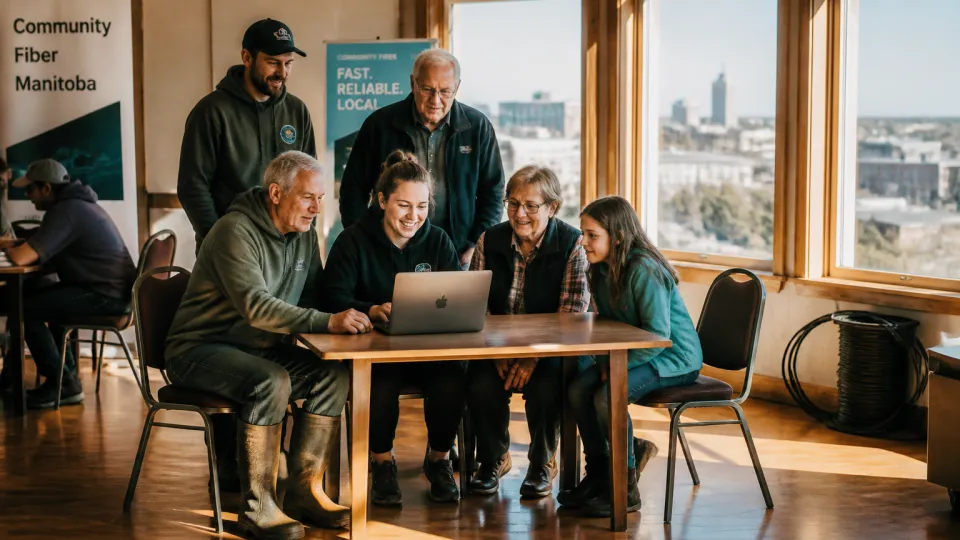
On a bright Tuesday morning in a converted curling rink outside Brandon, a circle of folding chairs faced a projector, laptops perched on laps. Evelyn Martin, 73, adjusted her reading glasses and logged into a video call with a doctor in Winnipeg. She had never done that before last month.
"I used to wait three hours in the clinic and go home exhausted," Evelyn said, fingers hesitating over the trackpad. "Now I sit here, and the nurse helps me. It feels like the clinic came to me."
Evelyn is one of dozens who have come through the Westman Digital Commons, an initiative born from an unlikely collaboration of Brandon University faculty, municipal planners, library staff, and a grassroots cooperative of farmers and small- owners. The Commons is less a building than a traveling program: pop-up digital literacy classes in halls, a lendable tablet library, and a rural help desk that shows up with coffee and patience.
What started as a reaction to the obvious problem — unreliable broadband and little digital training in outlying towns — has evolved into a pragmatic, place-based strategy for adoption. " adoption here can't be a parade of shiny promises," said Dr. Asha Patel, a sociologist at Brandon University who helped design the program’s curriculum. "It has to answer the everyday needs people already have: seeing a doctor, selling produce online, teaching a kid to code."
The Commons works alongside PrairieLink Fibre, a municipal partnership that has pushed fiber farther into the region over the past three years. But infrastructure was only half the fight. "We had the cables in the ditch," said Janelle Riel, a librarian in Rivers who runs evening classes, "and still, people thought the internet wasn't for them. That's where training and trust come in."
The program’s trainers are not all technocrats. They include high school students who tutor seniors in file naming conventions and farmers who help neighbors set up weather sensors. Tom Sinclair, 58, a mixed farmer near Killarney, uses soil moisture probes and a phone app to schedule irrigation. He remembers the first skeptical neighbors who asked whether sensors were "fancy toys."
"Now I send them a screenshot, and they call me about their own fields," Tom said. "It's not about replacing what we do; it's about doing it better. That's what convinces people." His operation hasn’t become Silicon Prairie overnight, but he has cut waste and booked a local agronomist’s time more efficiently thanks to staggered remote consultations.
Local entrepreneurs have found unexpected openings. Maya Chen, a 19-year-old from Neepawa, started an online artisan cheese subscription that connects her grandmother’s recipes to customers in Winnipeg and Calgary. The Commons helped her with e-commerce basics and packaging logistics. "If I’d stayed thinking I had to open a store, I might have left town," she said. "Instead, I’m building a business that keeps me here."
These stories underline a pattern: when technology answers a practical need and is taught within social networks of trust, uptake follows. Yet the work is iterative and often messy. The Commons wrestles with affordability — subsidizing devices and data for households between seasons — and with the slow bureaucracy of municipal procurement. They also confront an uneasy truth: digital tools can widen inequalities if not intentionally deployed.
To guard against that, program coordinators prioritize what they call "reciprocal training": young coders mentor seniors on video conferencing while seniors teach history, knitting, or machinery repair in return. The idea is not to erase differences but to fold them into a shared civic practice.
Looking forward, Westman’s experiment points to a larger regional strategy: pairing last-mile infrastructure investments with human-centered services. "You can’t measure success in megabits alone," said Dr. Patel. "You measure it in appointments kept, in new enterprises, in people not moving away because they can pursue a livelihood here."
There are no neat endings to scenes like Evelyn’s. Her arthritis flares unpredictably; some days the technology confounds her. But on the day she logged into that appointment, she stepped out of her house and back into a town that had adapted to keep her included.
The real achievement of Westman’s initiative is not the fiber in the ground or the apps on people’s phones. It is the social machinery — the patient tutoring at the library, the farmer who lends a tractor for a school field trip, the municipal staffer who stays late to fill out forms — that turns abstract potential into daily habit. As small towns across Canada reckon with demographic shifts and economic pressures, Westman offers a model that treats technology as a neighborly tool: earnest, useful, and rooted in place.
For towns that once measured connectivity by the hum of a rotary phone, the question now is believable and sharp: how can digital tools be shaped to sustain the rural life people value? The Commons answers it, not with declarations, but with a steady cadence of classes, cups of coffee, and the occasional, undeniable moment when a video call brings a doctor’s voice into a stranger’s living room.
Evelyn closed her laptop with a small smile. "It’s not magic," she said, "but it's changing how I live."
Outside, a spool of fiber cable caught the sun, a quiet emblem of work that is still being done.