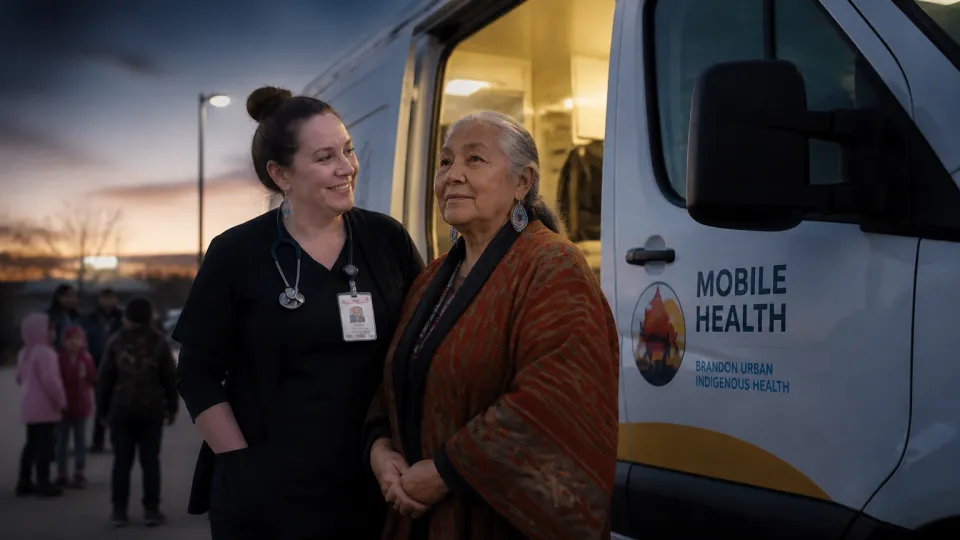
On a cold spring morning in downtown Brandon, a battered van idles outside a community centre, its side door flung open to reveal a folding table, stacked syringes being safely disposed of, and a young nurse laughing with a woman who has just received a flu shot. The scene is ordinary and, if you know the backstory, quietly revolutionary: decades of incremental , stubborn volunteerism, and fragile partnerships that together reshaped health care access in Westman.
The community-health movement here did not arrive fully formed. It was stitched together—first by neighbors, then by nurses and social workers, then by municipal and provincial agencies—often in reaction to crises. In the decades after the Second World War, Brandon’s growth exposed gaps: rural residents could not always reach a family doctor, Indigenous people were shut out of mainstream services, and mental-health and addiction support lagged behind need. What followed was not only the construction of clinics and programs, but a slow cultural change: health seen as belonging to the community, not only to professionals behind white coats.
Take, for example, the volunteer-run outreach efforts that began as simple responses to need. "We started with a folding table and tea," a longtime volunteer recalled, describing evenings when nurses would offer wound care and referrals to people who barred them from clinic doors during regular hours. Those improvised nights evolved into scheduled mobile clinics, then into partnerships with local shelters and community centres, and eventually into sustained funding streams. The work that began as compassionate stopgap measures forced institutional attention on persistent inequities.
Indigenous partnerships have been one of the most consequential shifts. In Westman, the early insistence of local First Nations, Métis leaders, and friendship centres on culturally safe care led to new models: clinics that make space for traditional healing, health educators hired from within communities, and protocols that respect treaty obligations. These are not merely symbolic changes. For many families, the presence of an Elder in a clinic or a nurse who understands local language and history is what makes seeking care possible.
Community paramedicine and primary-care networks illustrate how rural ingenuity became system-level innovation. Paramedics trained to provide scheduled home visits for chronic-care patients reduced emergency-department visits, while multidisciplinary primary-care teams—nurses, social workers, dietitians, and physicians—began to pool resources to serve dispersed populations. These programs also offered an important lesson: proximity matters, but so do continuity and relationships. A familiar face who understands a patient’s life is often more effective than episodic specialist care.
The human cost of this work is visible in small, everyday stories. A retired farmer who, after a series of outreach home visits, finally agreed to treat his diabetes; a teenager who found a counselling program through a school-based clinic and speaks now of finishing college; an Elder who insisted that an addiction program incorporate sweat lodge access as part of healing. These are not statistics; they are the quiet measures of trust rebuilt.
But progress has never been linear. Funding cycles, workforce shortages, and the geography of rural Manitoba continually stress systems. The COVID-19 pandemic exposed both the strengths and brittleness of community models: rapid local coordination produced effective vaccine clinics and outreach to seniors, but long-term staffing pressures and mental-health backlogs widened. The experience offered a blunt reminder that community-driven initiatives must be supported, not just celebrated.
Looking forward, and collaboration point to possible futures. Telehealth has already expanded reach for specialty care, but its promise will only be realized if broadband, digital literacy, and privacy safeguards are addressed. Equally important is investing in local training pipelines: scholarships, rural residency placements, and programs that recruit Indigenous and rural students into health professions. There is also a practical urgency to integrate traditional healing practices into mainstream care models with the full consent and leadership of Indigenous partners.
Perhaps the most important lesson from Westman’s history is humility: meaningful change rarely arrives as a top-down silver bullet. It emerges where people are willing to do the slow work of relationship—volunteers sitting at folding tables, Elders negotiating protocols, nurses staying late to translate medical jargon into plain language. These efforts do not make headlines, but they make care possible.
If policymakers and health leaders take one thing from Westman’s experience, it should be this: investing in systems that prioritize continuity, cultural safety, and local leadership is not optional. It is the foundation of resilient care. The challenge now is to move from ad hoc genius to durable structures—so that the battered van outside a community centre is not a symbol of improvisation, but an emblem of an organized, supported, and equitable health system for everyone in Westman.