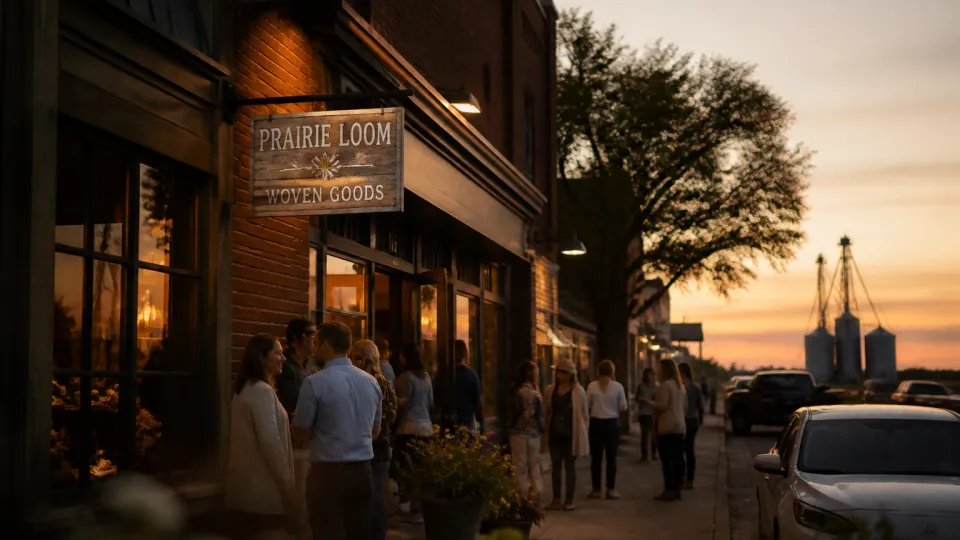
On a late November morning, the broken windows of a long-empty storefront on 10th Street have been replaced by panes fogged with kettles and conversation. Outside, a woman in a wool coat hands a paper bag of sourdough to a man carrying a toolbox. Inside, under exposed beams and a wall painted the colour of prairie sky, people are chopping carrots, assembling meal kits and sketching prototypes for a moisture sensor that could help a nearby barley farmer plan harvests.
The woman is Rhea Patel, forty-two, an entrepreneur who grew up in a mixed farm household west of Brandon and who returned after a decade in Winnipeg and two years in Toronto’s startup scene. Prairie Loom, the mixed-use project she founded in 2019, looks at first like a tidy answer to downtown vacancy — 18 modest rental units above ground-floor retail — but it is more ambitious: a communal kitchen and food hub, a small-scale ag-tech incubator, and a co-working space shared by artisans, technologists and non-profits.
Patel’s idea was simple in outline and stubborn in practice: stitch together uses that usually sit apart. "People think you solve a vacancy with condos or a coffee shop," she told me over espresso. "But Brandon’s strength is its layered economy: agriculture, logistics, education. The problem was there were no places where those layers actually talked to one another."
That conversation has measurable results. Prairie Loom’s food hub aggregates produce from five local farms and two community gardens, providing weekly meal kits to 120 households and steady processing work for a dozen part-time staff. Its ag-tech bench has supported three student-led startups from Brandon University and Assiniboine Community College, one of which is piloting a low-cost moisture probe now installed on 15 test plots across Westman. The co-working facility seats 30 people and hosts evening workshops on everything from bookkeeping for small farms to grant writing for arts groups.
The numbers matter because they anchor a different story — one of daily work and incremental civic change. "Rhea has been persistent about asking: what does resilience actually look like here?" said Mark Havel, a planner with the City of Brandon who has worked with Prairie Loom on zoning and small grants. "It’s not a shiny headline project. It’s people learning to make a living in ways that keep money in the community and invite newcomers into the ecosystem."
Patel’s approach is intentionally porous. One evening a newcomer family employed through Prairie Loom’s kitchen program arrived early for their shift and stayed for a neighbourhood meeting about winter warmth outreach. A retired electrician teaches practical wiring at the co-working space in exchange for a reduced studio rent. The project deliberately set aside six units at below-market rent for artists and essential workers, betting that mixed-income occupancy would create spillover benefits for adjacent businesses.
That bet has, so far, paid off in small but significant ways. A nearby hair salon that had teetered for months reports a 12 percent uptick in foot traffic; the city’s winter market is busier; and a delivery service run from a rear loading bay at Prairie Loom now connects local producers to Brandon College cafeterias. These are not blockbuster economic multipliers; they are local circuits shortened and made more reliable.
The project has not been without friction. Financing required a complicated weave of municipal loans, a modest provincial seed grant, community bonds and private capital. Local contractors who once specialized in conventional construction had to learn to build with communal kitchens, accessible apartments and lab-grade ventilation. And some neighbours worried that the building’s entrepreneurial focus might accelerate gentrification.
Patel listens to those concerns as carefully as she measures pods of soil. "We’re not trying to make a showpiece for investors," she says. "Our metric is: are people who live here better off six months from now? A new business, a steady check, someone shifting from isolation to part of a crew — those are the wins that sustain a place."
Looking forward, Prairie Loom casts a larger shadow. Patel is convening a Westman cohort — municipalities, colleges, farmers and small manufacturers — to pursue a regional supply-chain initiative that could reduce food waste and create year-round processing employment. She’s testing a model that other small Prairie cities might replicate: small, mixed-use anchors that amplify existing industries instead of displacing them.
Perhaps the most striking thing about this work is how modest it feels in the moment and how consequential it becomes over time. The practicalities — a shared walk-in cooler, a mentorship evening, an intern’s prototype winning a grant — accumulate into civic infrastructure. "Development here doesn’t have to be dramatic," said Lina Osei, a Prairie Loom kitchen supervisor who emigrated from Ghana five years ago. "It can be steady, human, and make room for the people already here."
If Westman’s future is to be inclusive growth rather than extractive expansion, it will depend on entrepreneurs who treat development as relational work — aligning capital to community rhythms and making space for ordinary creativity. Rhea Patel’s experiment does not solve every regional challenge, but it demonstrates a way of building that respects the region’s rhythms and multiplies its capacities. The prairie is not a blank slate; it is a fabric. Projects like Prairie Loom are not stitches that decorate it so much as seams that remake its strength.