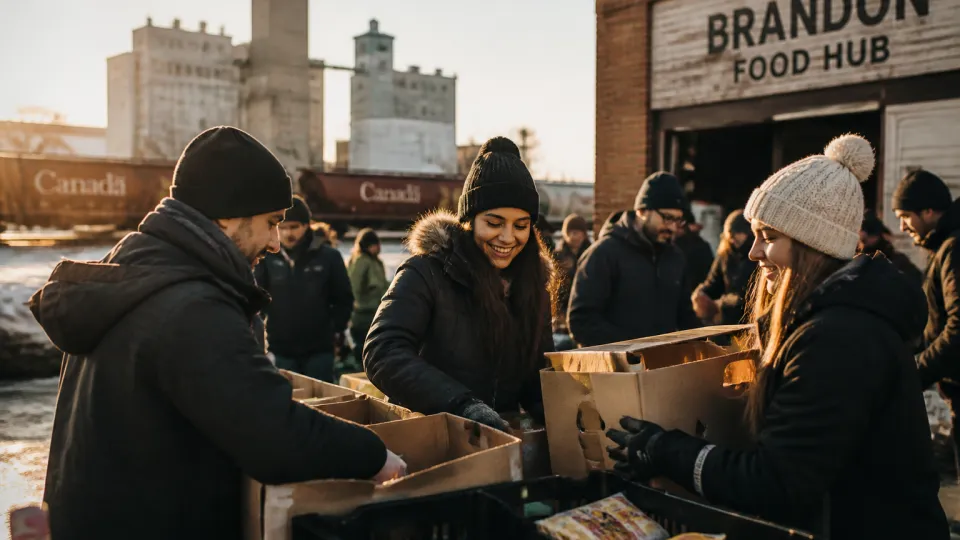
At 5:45 a.m., before the city has fully woken, Eleanor Martin’s car pulls into the loading bay behind the community food hub on Princess Avenue. Eleanor, a retired school librarian with an easy laugh and a calendar that looks like a patchwork quilt, sorts a delivery of dairy and bread alongside teenagers in high-visibility vests, a university student home for the summer, and two men who came straight from a graveyard shift at the hospital. They do not ask for credit. They ask if anyone needs milk.
That morning scene is emblematic of an invisible architecture that holds the Westman region together. Volunteers in Brandon and neighbouring towns such as Neepawa, Virden and Souris run services that are sometimes called auxiliary, often taken for granted, but very rarely replaceable. They staff food banks and hospital visitor programs, repair the community bus, deliver Meals on Wheels, and offer companionship to seniors in apartments where visits can be months apart. The work is ordinary, repetitive and utterly essential.
Volunteering here is not a poster campaign. It is a set of relationships. Take Noah, a Grade 11 student who started helping at the food hub to earn community hours. He came back because of Mrs. Patel, a regular client who now brings him jam from her kitchen. “She taught me to scoop peas properly,” Noah says, grinning. “And she tells better jokes than my uncle.” For Noah, the hour he gives every Saturday became an anchor; for Mrs. Patel, Noah’s presence is a small but steady proof she is still seen.
Or consider Jim Patterson, a retired mechanic who fixes the community’s minivan so the senior transportation program can run. He refuses any pay but keeps a list of maintenance tasks that reads like a map of local needs: brakes, winter tires, a heater that gives out every thaw. Jim’s work is not dramatic. It is the quiet tending of infrastructure that, when absent, would strand someone without a ride to dialysis or a grocery trip.
Brandon Regional Health Centre’s volunteer program offers another angle on impact. Volunteers there sit with families in intangible hours—between diagnosis and decision, between surgery and the first shaky steps home. “We are not clinicians,” Eleanor says, “but we are listeners. Sometimes that matters more than anything else.” The presence of someone who remembers the family’s name, brings a coloring book, or walks a ward’s periphery does more than fill hours; it humanizes systems.
Volunteerism also adapts in crisis. During last winter’s extended storm, community volunteers improvised warming stations and made house calls when power outages knocked out heat for rural households. The call tree started small—neighbors calling neighbors—and by the end of two days coordinated food, blankets and a temporary generator for one household whose home contained oxygen-dependent equipment. These responses rely on improvisation and trust, not just rosters.
Yet that improvisational genius can hide gaps. Volunteers are increasingly asked to do more complex tasks—transportation that involves mobility aids, peer support that intersects with mental health needs, food distribution that tracks dietary and cultural requirements. Many programs now must balance goodwill with formal training, liability concerns and the emotional toll burn-out can bring. In interviews, volunteers across the region described fatigue alongside pride. One young volunteer admitted she hadn’t expected to be the person who held someone’s hand through their last hour; she hadn’t been trained for grief work.
The future of volunteer service in Westman will be shaped by how communities answer that tension: honor and scale. Local organizations are experimenting with low-cost, high-impact investments—training modules in trauma-informed care; modest stipends for transport; partnerships with secondary schools that translate service into recognized skills. Municipal leaders increasingly see volunteer infrastructure as a public good, not an optional adjunct to social services. Conversations about volunteer banks, centralized recruitment platforms and shared liability coverage are nascent but promising.
Perhaps the most important shift is cultural. Younger volunteers want to see their time lead to measurable impact and personal growth. Older volunteers want to make sure their experience is valued. Bridging those expectations requires institutions that can do two things at once: keep the human warmth that makes volunteering meaningful, and offer structures that sustain that warmth without exhausting it.
Back at the food hub, Eleanor hands a volunteer a scarf dropped off that morning. She watches as a woman in an oilskin coat tucks it around her neck and steps back into the winter light with a bag of soup and the assurance that someone will check in next week. Eleanor rubs her hands together, smiling, then rolls up her sleeves to sort the next delivery.
That image—small, repetitive, profoundly ordinary—offers the clearest forecast for Westman’s future. The resilience of these towns will depend not on a single heroic act but on a thousand small ones, kept alive by systems that respect volunteers’ labor, share responsibility, and invest in training and coordination. If Westman can turn its improvised compassion into durable capacity, the region will not only survive the next crisis but meet it with a readiness rooted in people who have always, quietly, kept community afloat.