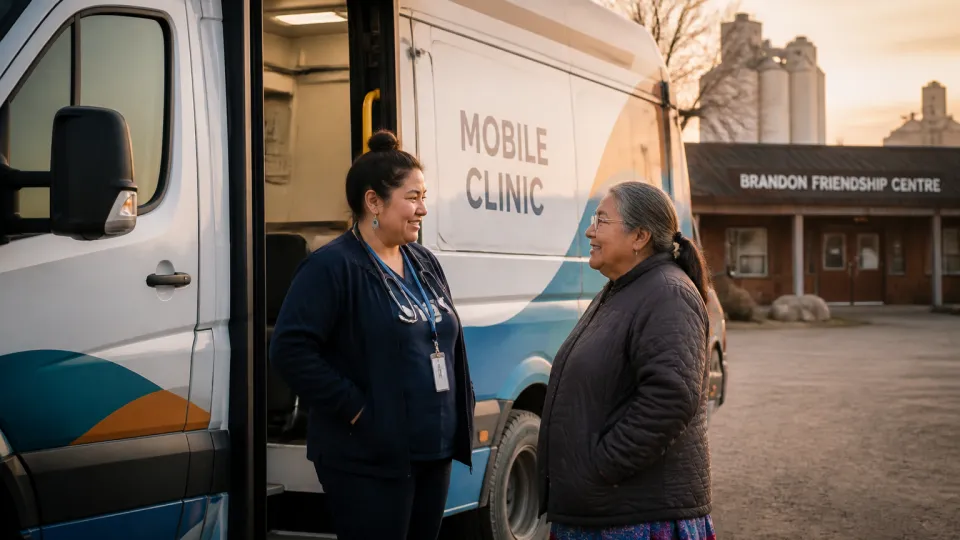
On an August morning in downtown Brandon, a white van with a prairie-blue stripe idles beside the brick façade of a neighbourhood church. The driver, a paramedic whose uniform is softened by a canvas cap, unlocks the side door and sets out folding chairs. By nine, a line of people has formed: an older man who rises cautiously from a cane, a young mother with two toddlers on her hip, a Dakota elder wrapped in a shawl. They have come for flu shots, wound care, a chat about medications, and, in small but essential ways, a reminder that someone will listen.
This van is one piece of a broader, quiet revolution across Westman. In a region defined by wide distances and a dispersed population, healthcare initiatives have emerged not as replacements for hospitals but as a distributed lattice of practical interventions: community paramedicine that brings basic diagnostics to a kitchen table, mobile clinics that park in school lots, Indigenous-led outreach that centers cultural safety, and partnerships with Brandon University and Assiniboine Community College that channel training into immediate service. Together, these projects are less about heroic than stubborn, place-based problem solving.
“There’s a difference between being seen and being treated,” says a community paramedic who asked to be identified by role. He describes a recent visit to a farmstead east of Brandon where an elderly woman had been struggling with medication management. “We brought the pillbox, sat down, talked about why she missed doses. No white coats. No rush. It changed how she took her medicines.”
Prairie Mountain Health, the regional authority that covers Brandon and surrounding municipalities, has supported several of these efforts. Its endorsement has given programs logistical wings: access to cold-chain equipment for vaccines, integration with medical records, and the administrative scaffolding that allows a volunteer-based project to bill and refer. But the energy, residents say, springs from grassroots networks — community health workers, Indigenous friendship centres, student clinics, and small non-profits that have learned to stitch services into people's rhythms.
Take the Brandon Friendship Centre's outreach program, which conducts regular wellness checks and culturally attuned health education. “Our people were being asked to come to systems that weren’t built for them,” says an Indigenous health coordinator. “So we went to harvesters and to community gatherings. We brought interpreters, elders, and clinical people together.” The result is care that looks and feels different: longer conversations, ceremonies integrated into care plans, and a respect for histories that shape health choices.
Students are not on the fringe of this work; they are woven into it. Nursing and social work students from Brandon University and nursing graduates from Assiniboine Community College find placements with mobile clinics and community paramedicine teams. For many, these rotations are formative. “In class you learn protocols,” a nursing student recounts, “but here you learn how to translate a diagnosis into a meal plan for someone who doesn’t have a grocery store within easy reach.” That translation is the work of equity.
There are concrete wins. Home visits by community paramedics have reduced non-urgent 911 calls from some rural pockets, freeing ambulance crews for true emergencies. Mobile mental health teams, collaborating with primary care providers, have shortened wait times for initial assessments in Brandon. And outreach vaccination drives improved uptake in neighbourhoods previously wary of institutional clinics.
Still, these gains are fragile. Funding cycles are short, and program leaders speak candidly about the strain of chasing grants to keep vans on the road. Workforce shortages — a national issue with local consequences — mean that continuity of care can hinge on a single staff member's availability. “ is the practical question,” says a program director. “You can pilot something that works, but if there’s no plan for steady funding and integration into the health system, the people who relied on it are left with a hole.”
Community leaders emphasize a different kind of sustainability as well: building capacity within Westman itself. That looks like training local residents as community health workers, creating mentorship pathways for Indigenous practitioners, and embedding reflexive evaluation so programs adapt rather than dictate. Telehealth, introduced widely during the pandemic, remains a tool — but residents stress it should augment, not replace, in-person relationships.
Walking away from the mobile clinic that morning, the paramedic mentions a man they see every season: a wheat farmer who declined to see a doctor for chronic pain because the clinic is “too far” and the wait is too long. “Now he trusts us,” the paramedic says. “He talks about his grandchildren. He wants to be able to work without fearing pain. That’s the measure.”
The story unfolding across Westman is neither miraculous nor uniform. It is, instead, a pragmatic choreography of people, vehicles, institutions, and cultural practices learning to move together. It is measured in fewer ambulance calls, in a grandmother remembering to take her medication, and in the slow rebuilding of trust between health systems and communities that felt marginal for decades.
Looking forward, the question is how to move from experiment to infrastructure. That will require policymakers to reckon with rural realities — not as exceptions but as central to provincial health strategy — and for funders to prioritize continuity. For practitioners on the ground, the work continues, modest and exacting: showing up, listening, and shaping care around the lives people actually lead. In the flat light of a Westman morning, that resolve feels, for many, like the most hopeful kind of progress.