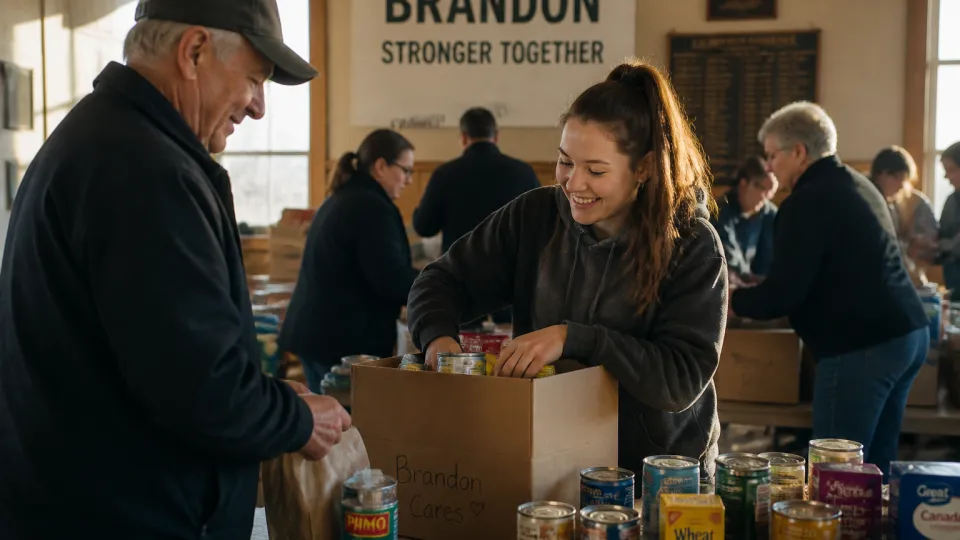
They come with thermoses, pickup trucks, and an encyclopedic knowledge of who needs what. On a Tuesday morning at 8 a.m., the back room of a modest community hall fills with the low hum of conversation: an elderly man folding blankets, a university student labeling produce for the food boxes, a retiree asking whether the new mother in town needs a hot meal. There is no ceremony to it — no banner, no television crew — only the practical choreography of people who have learned, often through necessity, to repair the small fractures that appear in any community.
Brandon and the surrounding Westman region have long depended on volunteer efforts that stretch municipal budgets and human patience. But what distinguishes the recent iteration of service here is a willingness to hybridize: traditional charity work melds with professional skills, academic programs, and informal social networks. Volunteering is less a single act and more a distributed infrastructure.
Consider the winter outreach operated from a storefront near downtown Brandon. It began as a few people handing out coffee and mittens during a cold snap. Today it coordinates rides for seniors, hosts a weekly pop-up health clinic staffed by nursing students from Brandon University, and runs a mentorship circle for recent immigrants learning to navigate local systems. “We realized quickly that handing out mittens wasn’t enough,” says Evelyn, a social work practicum student who now helps manage the schedule. “People needed information, company, and a way to feel useful again.”
That pragmatic improvisation is echoed in smaller towns across Westman. In Rivers, volunteer firefighters are not only first responders but also organizers of neighborhood emergency plans. In Carberry and Neepawa, volunteer-run community gardens have become small economic engines — selling excess produce at markets and donating year-round to food programs. These initiatives reveal how volunteers bridge gaps between formal services and everyday life, tailoring assistance to local rhythms and histories.
Stories of endurance often begin with a single catalytic moment: a flood that overwhelms a basement, a factory closure that upends a town’s livelihood, a youth centre losing funding. In each case volunteers are the first to notice subtle shifts in need. When a meat plant in the region reduced staff last year, volunteers at food programs adapted their distribution schedules and mobilized drivers to deliver groceries to newly underemployed families. “We don’t wait for reports to come down from the city,” says Miguel, who coordinates a volunteer driver network. “We call people we know and ask, ‘What changed for you this week?’”
That relational approach produces specific outcomes. Local volunteer tutors have increased high-school graduation rates in several schools by offering after-school learning pods; coordinated senior visitation programs have reduced preventable hospital trips by addressing loneliness and medication adherence; a coalition of volunteers and municipal workers recently rewired an aging community centre after discovering it was a hub for dozens of support programs.
Yet the system is not without friction. Volunteers themselves face burnout, shifting demographics, and sometimes unclear lines of accountability. A volunteer-run thrift store in one town struggled when its unpaid board was overwhelmed by administrative tasks. “We needed training in governance, not just shelving skills,” admits a volunteer manager. Increasingly, volunteers and nonprofits are calling for modest investments — shared training programs, small stipends for coordinators, and digital tools to manage schedules — that allow unpaid labour to be more sustainable and less precarious.
There is also an emerging ethic about who does the work. Westman’s volunteer scene is becoming more intentionally diverse: newcomers, youth, and Indigenous volunteers bring different perspectives and problem-solving approaches. A community cooking cooperative that began as a learning circle for refugee families now invites long-term residents to teach traditional Prairie recipes, creating channels for cultural exchange and mutual recognition.
Looking forward, the region’s resilience will depend less on heroic acts than on cultivating systems that amplify volunteer contributions. Smart investment — not extravagant funding, but predictable support for training, insurance, and coordination — could turn fragile patchworks into durable networks. Several municipalities have begun to explore volunteer liaison positions that bridge civic services and grassroots groups; local foundations are piloting microgrants to cover fuel and supplies.
The true measure of volunteerism here is not how many hours are logged but how these efforts change the texture of daily life. In Brandon, a single Saturday morning of community repairs might mean a shut-in’s porch light is fixed, a young father receives a child-care referral, and a newcomer learns to navigate the library system. These small successes compound, creating a social fabric that resists fraying.
If there is a lesson in the quiet heroism of Westman volunteers, it is this: community service succeeds when it sees people not as problems to be solved but as neighbours to be known. The future will require more coordination, fairer distribution of burden, and an openness to new volunteers’ ideas. But as the thermoses empty and the last box is packed on a given Tuesday, you can still see the same thing that has always sustained the region — neighbours showing up for neighbours, again and again, until a patchwork becomes a safety net.