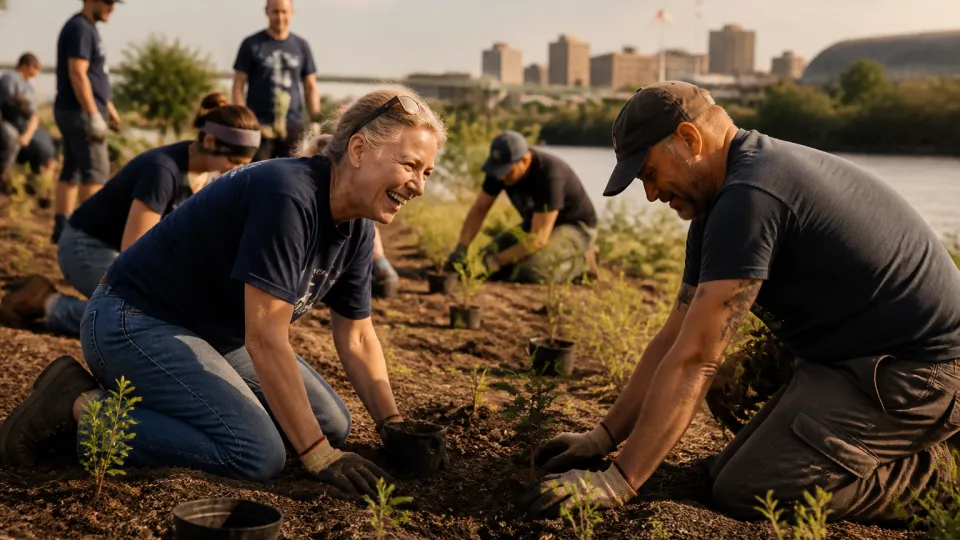
The morning began with a light wind off the Assiniboine and the smell of coffee drifting through the Riverbank Discovery Centre. Tents, folding tables and a scattering of plants created an improvised classroom: a handful of farmers with sun-darkened forearms, high-school students still wearing backpacks, municipal staff in fleece jackets and a circle of volunteers mapping a neighborhood’s drainage with a paper-and-pen earnestness that felt, for the moment, like ceremony.
The event—part forum, part hands-on fair—was not about grand pronouncements. It was about plumbing. It was about who pays for a rain garden and how to convince a landlord to install a second-hand solar array on a flat roof. It was about the daily logistics of living under a changing climate on the prairie: spring floods creeping earlier, summers that bake the topsoil, and an ever-present, quiet question about how resilient a small city can be.
"Resilience is less a policy and more a practice," said Marie Kostiuk, a Riverbank volunteer who helped organize the weekend. "People here want things that work for their yards, their roofs, their pocketbooks. They want to see the difference in the next season." Her voice carried the patience of someone who has watched good intentions fail because they were not tied to the community’s rhythms.
Across the grounds, practical demonstrations framed the conversation. Students from Brandon University led tours of a small constructed wetland built last year with community donations and a modest municipal grant. The wetland, designed to slow runoff and filter nutrients before water reaches the Assiniboine, now hums with insect life and a surprising clarity in the sampling bottles volunteers pulled from shallow water. "We measured phosphorous last summer and it was down 30 percent compared to the inflow last year," said Dr. H. S. Patel, who supervises undergraduate field projects. He emphasized that the numbers are localized, but the signal is clear: modest interventions can yield measurable improvements.
On another table, a cooperative of three westman farmers displayed a rotating composting rig they had retrofitted from grain equipment. The rig sits in a shaded yard and turns compost faster, reducing on-farm waste while feeding cash crops with rich organic matter. "We’re rebuilding the soil because it’s an insurance policy," said Logan McBride, a third-generation farmer. "Not flashy, not instant, but when the rains come hard or the heat comes, healthy soil holds. It’s cheaper in the long run and it keeps crops alive when extremes hit." Their model, shared with neighboring farmers through weekend workshops, is slowly eroding the old divide between conservation and productivity.
There were also intimate panels about energy efficiency in older homes and a gritty breakout session where renters traded tips for installing low-cost insulation and draft-proofing without landlord buy-in. In a city of just under 50,000 people, these small gains multiply. When dozens of homes weatherize, when a municipal stormwater plan favors bioswales over curb-and-gutter, the cumulative effect alters the way a place heats, cools, drains and grows food.
Yet the weekend exposed constraints as well as ingenuity. Funding was a constant refrain—most projects have short-term grants, modest budgets, and a reliance on volunteer hours that threatens continuity. "We need to be able to pay people to manage these things," said an organizer from a community garden collective. "Otherwise the knowledge sits with volunteers until life gets busy and projects stall." Translation: local momentum needs institutional scaffolding if it is to outlast the season of enthusiasm.
What makes the movement in Westman notable is its rooted, cross-sector character. City planners, university researchers, farmers, Indigenous knowledge-keepers and high school groups showed up not as separate silos but as collaborators. That is no small feat in a region used to working with tight budgets and long distances. It is also where the community’s capacity to adapt becomes visible: through relationships, experimentation, and shared labor.
One afternoon, a teenager named Aaliyah kneeled by a rain garden and showed a retired mechanic how to identify native milkweed from invasive thistle. "It’s like fixing engines," she said. "You learn to notice what’s wrong and then you know which tool to use." Her metaphor landed easily—repair culture and ecological stewardship braided together in a single gesture.
Looking forward, the challenge for Brandon and its surrounding communities is to convert these ad hoc successes into durable systems. That will mean tying pilot projects into city planning, establishing community maintenance funds, and creating pathways for knowledge transfer so practices can spread beyond the people who started them. It will also mean creating economic incentives that recognize the labor of care: soil-building, flood-mitigation planting, compost management.
There is an unmistakable optimism in the work here, but it is practical and earned. The movement does not promise salvation; it promises increment and accumulation. If a wetland filters phosphorus on one tributary and a neighbourhood installs twenty rain barrels, the future looks measurably different for that block. If co-ops of farmers slow a field’s runoff and build carbon in the soil, community food systems become a little more resilient to shock.
The weekend closed with a plain, citizenly task: a map of assets and needs pinned to a plywood board, scrawled with names, tools and promises. It was not glossy. It was a ledger of appetite: who can host the next workshop, who has extra lumber, who can teach a course in septic-safe composting. In that list, the real story of Westman’s adaptation emerges—not as a project delivered from above, but as a slow, collective accumulation of small, sensible acts that, together, will determine whether this prairie city breathes easier in the decades to come.