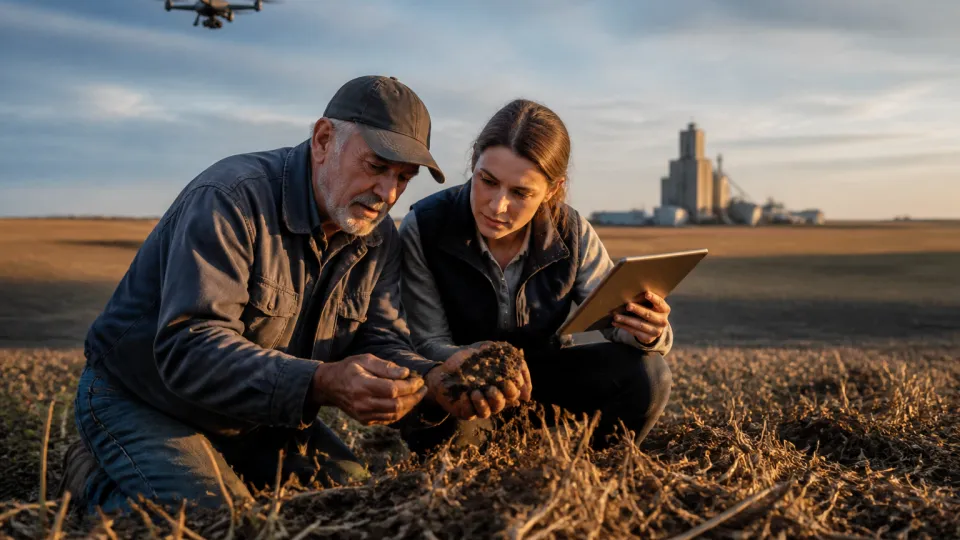
On a wind-stitched morning just outside Brandon, a line of tractors, trailers and pickup trucks converged on a quarter-section of winter wheat that had been planted with a contestable new plot: narrow strips of cover crops, a band of perennial pulses and a test grid for subsurface sensors. The event—organized by the Brandon Research and Development Centre in partnership with community groups—was billed as a field day but felt more like a civic gathering. Farmers stood in small knots, boots on rutted earth, while graduate students and startup founders traded data printouts and soil cores.
The scene was emblematic of a quietly accelerating shift across Westman: agricultural is no longer only about bigger yields or faster combines. It is about resilience and relationships—between people and land, between long-established farm families and new technologists, and between regional history and a changing climate.
Dr. Maya Singh, a soil scientist at the research centre, walked the rows with an old farmer’s posture and a scientist’s inventory. "We need to think in layers," she said, tapping a section of the test plot where cover crops had improved infiltration after a dry summer. "There’s the biological layer, the mechanical, the data layer. The innovation is the way those layers talk to each other in this landscape." Singh’s team is testing how low-cost sensors paired with variable-rate seeding can reduce fertilizer use while improving soil organic matter—an approach that, if scaled, could help local operations cut input costs and build long-term productivity.
At one demonstration table, Aaliyah Peters, a Brandon University graduate and cofounder of PrairieSense, unrolled a small circuit board the size of a matchbook. Her company’s sensors relay hourly soil moisture and nitrate levels to a community dashboard accessible on a farmer’s phone. "We built this because a lot of farms are told they need expensive proprietary systems," Peters said. "If the data is open to the community, it becomes a public good. Neighbours can see trends and plan together." The dashboard, she emphasized, is not about surveillance but about shared stewardship.
That language resonated with Gary Hnatiuk, whose family has farmed the same quarter-section for three generations. He showed me a strip that last year had become compacted after a late-season harvest. By adopting controlled-traffic seeding and experimenting with a rye cover crop, he said he saw early signs of recovery. "It’s a lot of small decisions," Hnatiuk said. "We’re not chasing some miracle machine. It’s changing how we manage the soil so our kids can farm it differently than we did." For him, innovation is incremental—and deeply tied to place.
Indigenous knowledge arrived at the event through quieter but equally forceful conversations. Elder Murray Crowfeather, of a nearby Dakota community, spoke about ancient land practices and the need to combine them with modern science. "Our elders always looked after the land’s memory," he said. "Sensors are useful, but you also have to listen." Crowfeather is collaborating on trials that reintegrate native plant species into buffer zones, aiming to enhance biodiversity and stabilize watercourses that local fishers and farmers both depend on.
The innovations on display were technical and tactile. Agronomists demonstrated a drone that maps variability in fields; a cooperative of grain elevators outlined a pilot for on-farm grain quality sensors that could shorten the time to market; a nonprofit showcased a mobile workshop that brings regenerative grazing lessons to small- and mid-sized operations. The human throughline was clear: without social channels is brittle. The real task is building institutions—training programs, cooperative data trusts, retrofit subsidies—that help communities adopt and adapt tools.
There are already signs of tangible impact. A pilot program coordinating sensor networks across eight farms has reduced average fertilizer application by 18 percent without yield loss, according to preliminary reports from the research centre. Local youth who returned for internships at the field day described how hands-on experience convinced them to remain in Westman rather than moving to larger urban tech hubs.
Still, challenges persist. Financing remains uneven for smaller producers, data governance raises thorny questions about ownership, and the policy environment often lags behind practice. "Innovation happens on the patchwork," Dr. Singh said, "but to turn patchwork into durability we need coherent policy—rural broadband, accessible financing and collaborative governance of data. Otherwise, it benefits only the early adopters."
As the afternoon sun flattened across the prairie, conversation shifted from demonstration details to the longer arc of community resilience. People who had arrived as strangers—researchers from Ottawa, a young entrepreneur, an Ojibway land steward, a third-generation farmer—left with a different sense of what is possible. The field day did not sell a single silver-bullet technology; it offered instead a rehearsed set of practices and relationships that together can bend the region away from vulnerability.
The longer experiment happening in Westman is as much social as it is technical. If successful, it will be measured not simply in yield tables but in whether towns like Brandon can sustain diverse local economies, keep young people engaged, and steward soil and water in a more uncertain climate. That will require continued curiosity and patient work: sensors that last through a prairie winter, training programs that respect local knowledge, and policies that treat data as a shared civic resource. For now, standing in the field as a drone hummed overhead and a farmer showed a healed furrow, the future felt less like a forecast and more like something being painstakingly grown—one practice, one partnership at a time.